


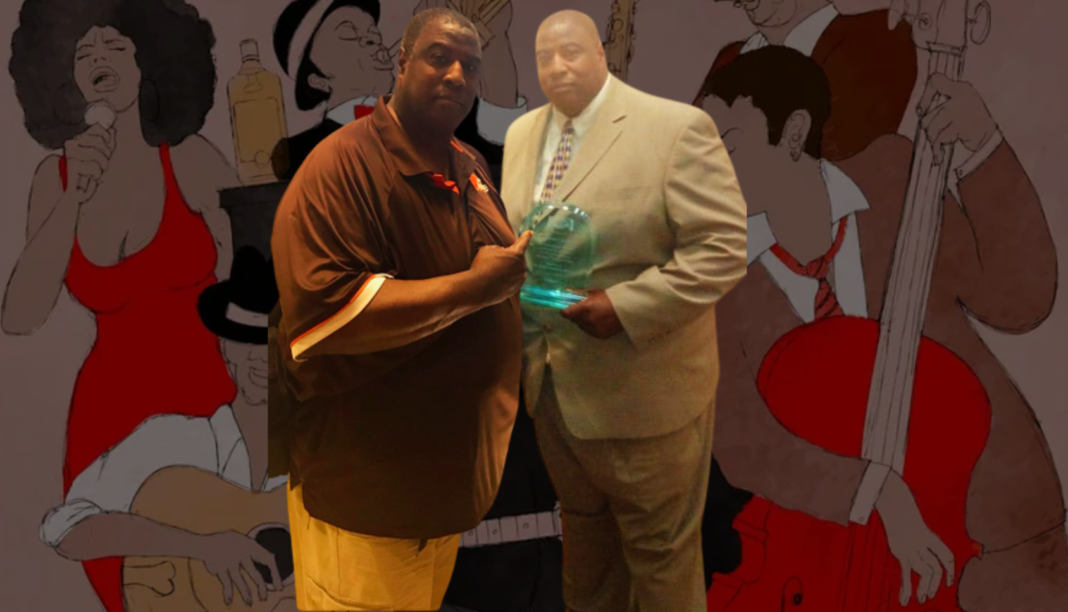

SPRINGFIELD, Mass. — On a quiet block of New England’s post-industrial landscape, the rhythmic pulse of diverse soulful music, cultural activism, and generational mentorship continues to resonate thanks to one man: James “Woo Bear” Lewis.
For more than four decades, Lewis has quietly operated as the gravitational force behind much of Springfield’s independent and community-rooted music culture. Equal parts record-store philosopher, radio DJ, and cultural organizer, Lewis has never sought the spotlight, yet his impact has long illuminated the path for others.
“I wasn’t an A&R guy,” Lewis said in a recent interview. “We were lifestyle marketers. We passed out flyers, we put our ears to the street, we listened, and we helped shape what people wanted to hear.”
His official role may be as a host on 90.7 WTCC, the radio station of Springfield Technical Community College, but Lewis’s true title might better be described as cultural architect. A native of Massachusetts who spent formative years in California, Lewis is a living record of how music scenes are built, nurtured, and sustained by those who work behind the curtain.
“A lot of folks think I played an instrument. I didn’t,” he said. “But I made sure everybody else got heard.”
From an early age, Lewis was immersed in sound and social energy. He began by carrying records for James Williams, a local DJ known as the “Soul Communicator.” A move to San Jose during high school brought him into contact with Black youth leadership programs and a vibrant local music scene. At San Jose State and surrounding neighborhoods, Lewis witnessed parties that attracted hundreds, DJs who shaped city soundtracks, and organizers who fused entertainment with civic awareness.
“That was the first time I saw music as a platform,” he said. “Not just for fun, but for building something.”
He stayed in California through the end of high school and briefly attended community college, absorbing the environment of creative Black excellence around him. He was surrounded by emerging event promoters, engineers, musicians, and community leaders. His circle included neighborhood DJs, students organizing NAACP youth protests, and entrepreneurs with a vision for blending business with community impact.
Returning to Massachusetts in the early 1980s, Lewis brought those sensibilities with him. He began working at local record stores, including Music Shack and Music Center, where he forged relationships with regional promoters, artists, and retail representatives. He organized parties at Springfield College and American International College (AIC) and eventually became deeply involved with 90.7 WTCC. His radio shows provided a platform for Black music, local voices, and cultural dialogue, often airing slow jams, jazz, and underground house music that had no other outlet.
Lewis was also one of the few local radio hosts who offered regular airtime to social justice advocates. He gave microphones to community leaders working on gang prevention, youth programming, and public affairs. This dedication to service earned him the respect of peers and listeners alike.
“You don’t even realize how much he’s doing until you look back,” one longtime collaborator said. “He doesn’t brag. He just makes it happen.”
In the late 1990s and early 2000s, Lewis and his colleague Ross co-founded the Tastemakers, a feedback collective that brought DJs, club promoters, and music fans together to listen to new releases, gauge audience reaction, and help regional labels make informed promotional decisions. In an era before social media, the Tastemakers meetings acted as cultural barometers. Their influence extended across Springfield, Hartford, New Haven, and beyond.
Their work in street marketing expanded from there. Lewis and his team created local campaigns for artists like Erykah Badu, Common, and Usher before those names reached national prominence. He built trusted relationships with music industry insiders in Boston and New York, many of whom remain in contact with him today.
“It wasn’t about money,” he said. “It was about impact.”
Lewis’s generosity is legendary. Even now, when a former mentee reaches out from a city hundreds of miles away, he’s likely to offer a connection, advice, or even coordinate new opportunities. That inclination to give, without keeping score, stems from the radical hospitality he experienced in California.
“I thought I’d be bullied,” Lewis recalled of his early days at a San Jose high school. “But people invited me into their homes. That stayed with me.”
Today, his reputation as a cultural elder, mentor, and connector remains intact. Whether it’s helping a record executive find a hockey coach for her son or introducing a local youth organization to a national contact, Lewis keeps opening doors.
“I tell young people,” he said, “be consistent. Show up. Don’t chase credit, chase connection.”
For Springfield and beyond, James Lewis is more than a DJ or a cultural organizer. He is a steward of memory, a node in the network of Black cultural sustainability, and a testament to what one man can do with a deep record collection, a generous spirit, and a refusal to quit.