


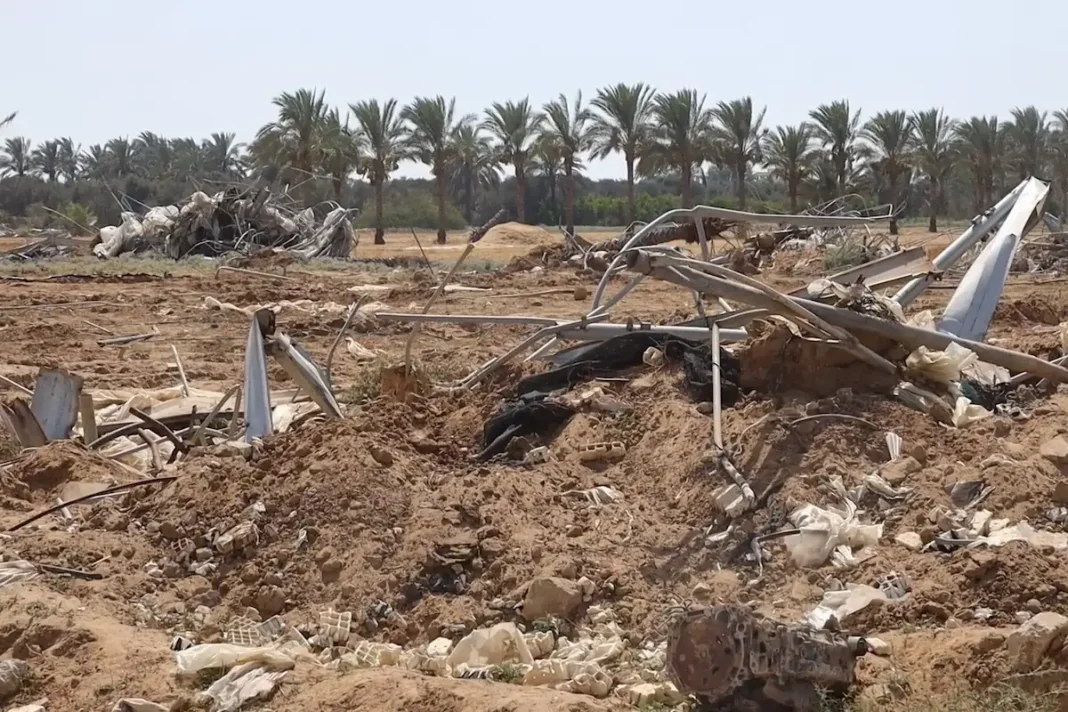

With 86% of Farmland Destroyed, Palestinians Face Deepening Food Crisis
By The Metro Record
In the Gaza Strip, a region once capable of sustaining its population through local agriculture, farmers are now fighting an uphill battle to grow food amid widespread destruction, displacement, and limited resources.
According to the Food and Agriculture Organization (FAO), approximately 86% of Gaza’s agricultural land has been severely damaged. Greenhouses, irrigation systems, wells, and orchards—once the backbone of local food production—have been destroyed, leaving farmers with few options to rebuild.
For many, the issue is no longer just about farming. It’s about survival.
A Broken Agricultural System
Ahmed al-Astal, a farmer who once owned productive land in Gaza’s eastern region, says the shift has been devastating.
“You’re talking about two million people relying on what used to be 100% of our agriculture—now reduced to maybe 10%,” he said. “We had surplus and quality before. Now we have shortages in seeds, fertilizers, and basic supplies.”
Today, farming is largely limited to small pockets like Muwasi Khan Younis and parts of Deir al-Balah. These areas are not nearly enough to meet the needs of Gaza’s population, which exceeds two million people.
Rising Prices, Shrinking Access
The collapse of local agriculture is already hitting families hard.
Farmers like Ibrahim Abu Shehab say the lack of fertilizers and farming supplies is driving up costs, making it more expensive to grow and sell produce. As a result, food prices in local markets continue to rise.
For displaced residents like Asrar Qadih, that reality is felt every day.
“Vegetables are expensive now,” she said while shopping in a local market. “We used to buy two or three kilos. Now we can only afford one or two pieces.”
The shift from abundance to scarcity has forced families to ration basic foods—an alarming sign of a deepening food insecurity crisis.
Displacement and Loss Compounding the Crisis
Repeated displacement has further disrupted Gaza’s agricultural cycle. Farmers who return to their land often find their crops destroyed or their soil no longer viable.
What was once a stable system of planting and harvesting has become unpredictable and fragile.
Without consistent access to land, water, and supplies, rebuilding Gaza’s agricultural sector remains a significant challenge.
A Path Forward: Rebuilding Food Security
Despite these obstacles, farmers continue to plant where they can—demonstrating resilience in the face of overwhelming conditions.
But experts say recovery will require more than individual effort. Restoring Gaza’s food system will depend on access to land, agricultural inputs, and long-term investment in rebuilding infrastructure.
At its core, this crisis is about more than food.
It’s about restoring a community’s ability to sustain itself.