



Memory, Spirit, and the Presence We Don’t Name
By Darryl E. Moss
Editor’s Note
In this reflection from Savannah, Georgia, Darryl E. Moss shares a personal moment that opens into a broader meditation on memory, spirituality, and the ways the past can still live with us.

There are moments in life that do not ask for permission. They arrive quietly, but they land with authority. You are walking, minding your business, and you hear your name. Not loud. Not in panic. Softly. Clearly. As if someone familiar is calling you. You turn. No one is there. Convince yourself that it’s nothing. You keep walking.
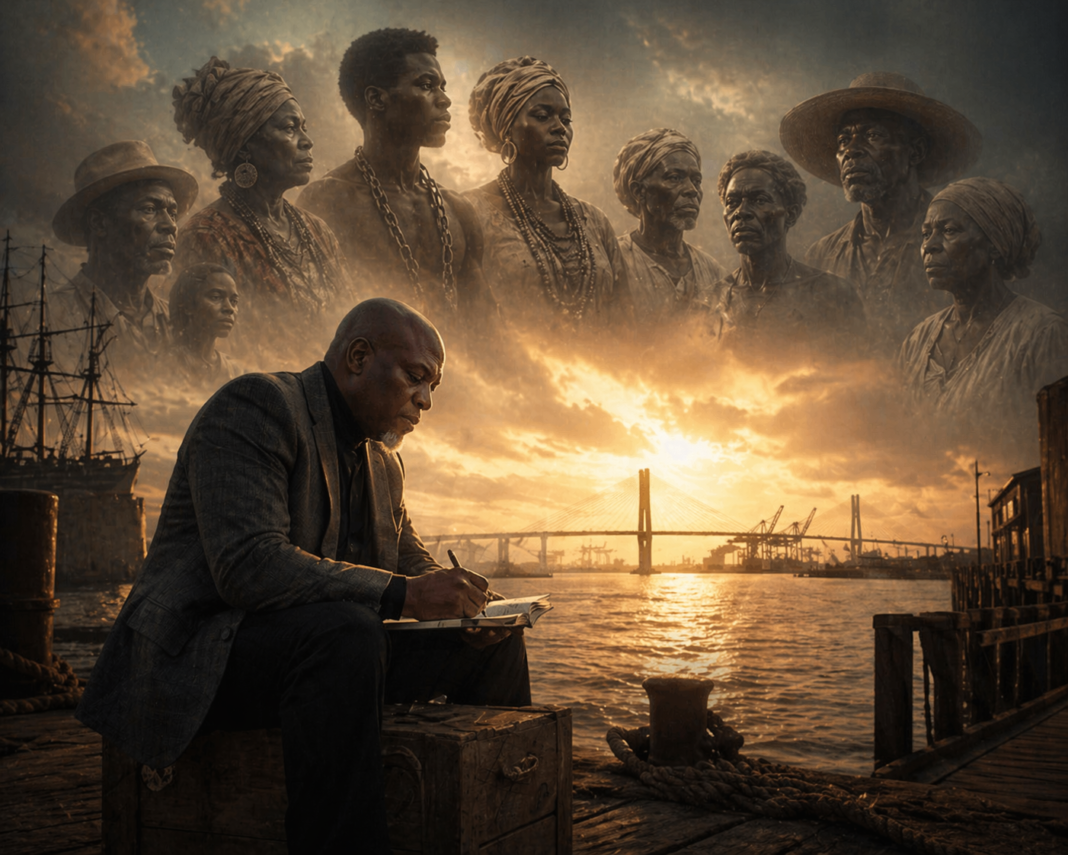
I had one of those moments in Savannah. I was there for a legislative conference, staying along the river, one of those places designed for ease, where people come to take in the view and enjoy the charm of a historic Southern city. One evening, I stepped out onto the boardwalk. There was laughter, conversation, the steady rhythm of water moving beside us. For most folks, mostly tourists, it was exactly what it appeared to be. A beautiful night. A peaceful setting.
But something in me shifted. As I walked, a feeling settled in, not fear, more so awareness. The kind that makes you slow down, look around, and listen closely. Because in places like that, both the water and the soil carry our memory. The water has carried bodies, tears, prayers, and passage. The soil absorbed blood, labor, footsteps, and struggle.
Standing there, I found myself asking a question I had not planned to ask. I asked Yemaya whether she still existed within the waters, especially in rivers that once carried the souls of the captured and enslaved. And in that moment, the breeze shifted. Not dramatically. Not in a way that would turn heads. But gently. Reassuring. Almost kind. It didn’t answer in words. But it didn’t feel like silence either.
As a descendant of enslaved Africans, I know the history. I understand the timelines, the systems, and the documented facts. But standing there on that riverwalk, this was not history being neatly compartmentalized as something distant or complete. It felt present. Active. Alive in a way that was ethereal but unmistakable.
And then there are the quieter moments. Like opening a book at random, and the words hit you personally, right where you stand. You pause. Reread and begin to feel that rise along your arms. Almost recognizable. Familiar, as if something in you already knows.
Some will call that coincidence. A case of the brain finding patterns, filling silence, and creating meaning where none exists. Maybe. But if you pay attention long enough, you begin to notice something else. Not proof in a laboratory or scientific sense, but a pattern in a human one, something that insists on being acknowledged, even if it cannot be neatly explained.
We are often taught, particularly within Western traditions shaped by Christianity, that death creates a final separation. That once a person leaves this life, they are gone from this realm entirely, waiting somewhere beyond reach for the coming of something in a religious capacity. It’s a clean framework. Structured. Orderly. A learned expectation. But it is not the only one, and for many, it has never fully explained what we know we sense and feel.
Long before that framework reached these shores, many African societies understood existence differently. In traditions connected to Yoruba cosmology and others, the line between the living and the departed is not a wall. It is a veil. Thin. Permeable. Interactive. The ancestors are not absent. They are present in another form, still connected through memory, ritual, and awareness. That understanding did not disappear under slavery. It adapted.
People were stripped of language, land, and formal systems, but the spirit is not easily erased or disconnected from the essence of what was and still is. It survives. It reshapes itself. It speaks in ways that are not always obvious. That’s where spirituals come in, not just songs, but whispers from across the veil. These were not simply songs about God. They were created in bondage, carried through pain, sung under surveillance. They held grief, resistance, coded communication, and the quiet assertion of humanity. Steal Away was not just about heaven. Wade in the Water was not just about baptism. They carried layered meanings because the people who created them lived layered realities.
So when we ask why they were called spirituals, the answer becomes clearer. They were not just expressions of religion. They were acts of preservation, connection to something deeper than the conditions imposed upon them. What we call spirituality in this context is not abstract or distant. It is relational. The departed are not simply remembered; they remain part of an ongoing exchange. Guidance is not always spoken, but it is felt. Presence is not always visible, but it is recognized. The line between the living and the departed is not closed. It is continuous.
And perhaps that brings us back to those moments we struggle to explain. The whisper. The pull. The page that meets you exactly where you are. Are these simply tricks of the mind? That is one explanation. But there is another question worth asking. What if those moments are not interruptions, but connections? Not proof of something mystical in the way we have been taught to define it, but evidence that our understanding of life, death, and presence may be incomplete.
Across cultures, across centuries, there is a recurring idea: the living are not entirely alone. That does not mean every unexplained feeling is an ancestor reaching out. It does not require abandoning reason or embracing fantasy. But it does invite a reconsideration of whose frameworks we accept, and whose ways of knowing we have been taught to dismiss. Because for many, particularly in the African diaspora, this is not new. It is remembered, embedded in our DNA, lying in wait deep within our subconscious selves.
Standing on that river in Savannah, with the breeze moving gently across the water, it did not feel like imagination. It felt like continuity. The question isn’t proof. It’s this: Are you willing to sit with the whisper?