


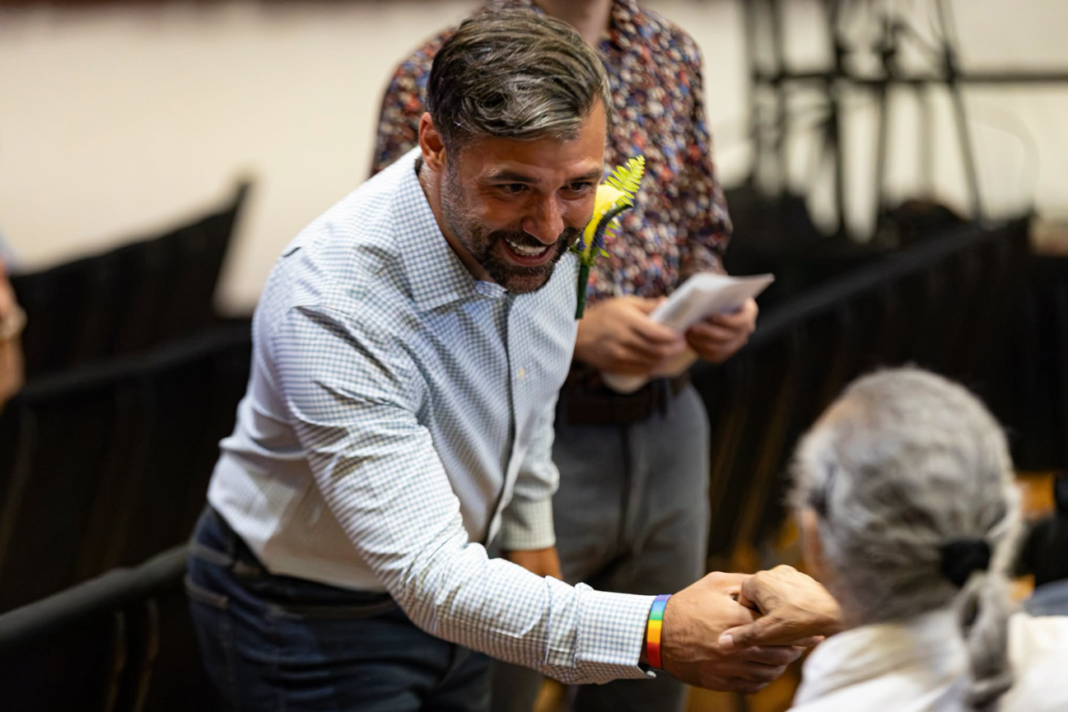

SPRINGFIELD, Mass. Jeromie Whalen says his campaign for Congress is proving that sustained community relationships can challenge decades of political power in Massachusetts’ 1st Congressional District.
The South Hadley educator and Democratic candidate is running against longtime U.S. Rep. Richard Neal in the Sept. 1 primary. Whalen has built his campaign around direct voter contact, local events, door knocking, and a commitment not to accept corporate PAC money. He says voters increasingly want a representative who is visible, accessible, and accountable beyond election season.
In a recent conversation with The Metro Record, Whalen said the distinction between his campaign and the incumbent’s approach is clear: “You don’t build trust with a bus tour. You build it by showing up, again and again. When there’s a problem, when someone needs help, when there’s no press around and nobody’s watching.”
Relationships before political access
Whalen said his campaign has focused on building authentic connections with people across the district, from Springfield and Holyoke to the Berkshires, the Hilltowns, and Central Massachusetts.
He described spending entire days at neighborhood gatherings, meeting business owners, talking to residents, and bringing young people into the political process. At the African Community Festival, Whalen said he attended with a teenage volunteer who helped distribute literature and speak with voters.
Those personal encounters, he said, matter because they build a kind of accountability that cannot be manufactured through short visits, controlled appearances, or political mailers.
“When you create that community, it is hard to turn your back on people,” Whalen said.
Whalen’s campaign says it has made a point of reaching all 83 municipalities in the district, which stretches across roughly 30 percent of Massachusetts’ land area. He has described the work as an effort to understand local concerns rather than impose a one-size-fits-all political agenda.
Voters demand more access
Whalen said constituents are becoming more outspoken about the absence of direct public engagement from their longtime congressman. The issue gained greater attention after Neal declined to attend the Aug. 11 community candidate forum at 52 Sumner Ave. in Springfield, which was organized by 44 organizations and community groups.
Whalen and fellow candidate Nadia Milleron participated in the forum. Neal has agreed to a televised WWLP debate with Whalen in Aug. The debate will be held on Wednesday, August 26, from 12:30 to 1 p.m. It will be rebroadcast at 7 p.m. InFocus host Patrick Berry will moderate the discussion.
Neal is seeking his 19th term representing the 1st Congressional District in the U.S. House of Representatives.
Whalen said residents should expect candidates to answer their questions in public, especially when working families are facing rising costs, health care concerns, housing instability, and uncertainty about the future.
He argues that representation means more than maintaining name recognition or long-standing ties to political institutions. It means being present in communities, listening to criticism, and standing with people when there is no political advantage to doing so.
“People talk,” Whalen said. “When you are actually out there with people, that matters.”
Grassroots campaign gains momentum
The Whalen campaign has relied heavily on volunteers and in-person organizing. In a recent campaign push in Springfield, Whalen said 85 volunteers knocked on 3,100 doors, part of a broader effort to reach residents directly before the primary.
Whalen sees that organizing model as a contrast to campaigns powered by corporate donations, consultants, and political insiders. He has pledged to refuse corporate money and says that decision reflects where his loyalties lie.
“Doing this without taking any corporate money shows exactly where my commitment lies, with my communities,” Whalen wrote in a Progressive Massachusetts candidate questionnaire.
His platform includes Medicare for All, stronger labor protections, a living wage, affordable housing, tuition-free community college and vocational training, environmental action, and greater investment in public education.
Whalen also supports a congressional stock-trading ban, a five-year lobbying ban for former members of Congress, and overturning the Supreme Court’s Citizens United decision, which he believes has allowed corporate money to distort democracy.
A different vision of leadership
Whalen said the campaign is reaching people who have long felt that their voices were treated as secondary to the interests of politically connected donors and institutions. He believes many voters are now asking whether decades of familiarity with an incumbent have translated into enough tangible progress for their communities.
He said those questions are especially urgent in Black and brown neighborhoods, among working-class families, and in rural communities that often feel excluded from decisions made in Boston and Washington.
Whalen’s campaign is rooted in the belief that public office should be an extension of community service. His campaign biography emphasizes his background as an educator, union member, volunteer, and mentor, and his commitment to representing workers, small-business owners, veterans, immigrants, students, and families throughout MA-01.
For Whalen, the race is ultimately about whether voters believe meaningful change can come from the ground up.
“This campaign is being built in living rooms, churches, kitchens, community events, and on people’s front steps,” he said. “That is where real democracy starts.”