


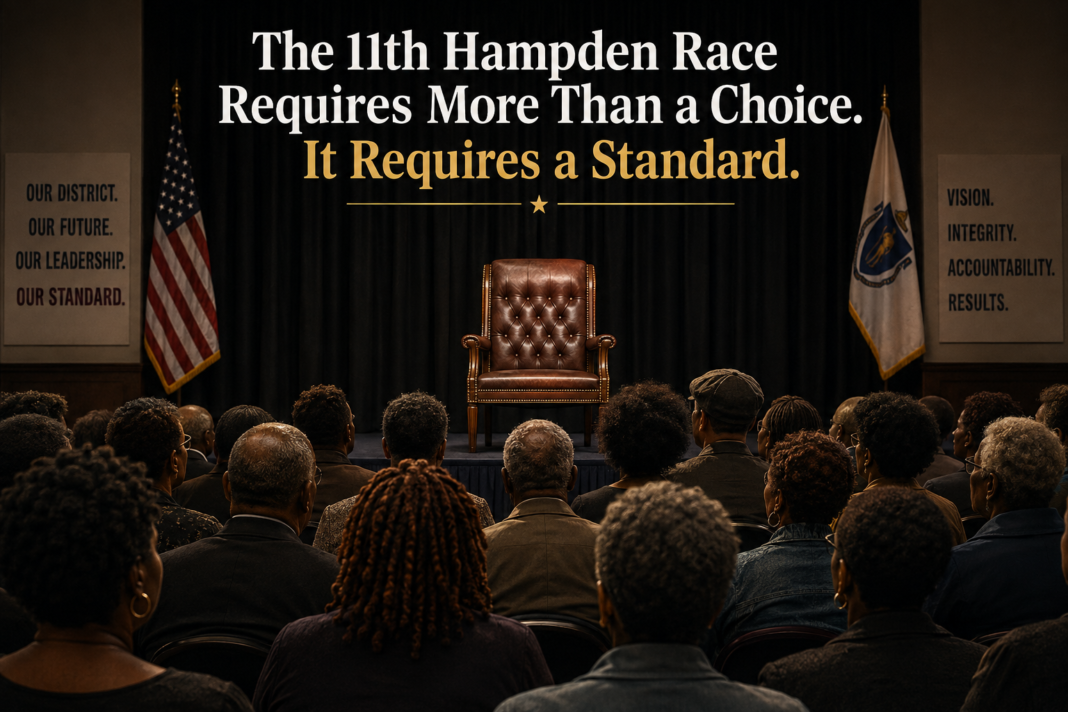

The September 1 Democratic primary is not simply a decision about who will hold a State House seat. It is a test of what Springfield residents should demand from political leadership.
The Democratic primary in Springfield’s 11th Hampden District features incumbent Bud Williams and challengers Nicole Coakley and Johnnie McKnight. Their names are the three certified Democratic candidates on the ballot. Donnell “Donny” Wright, who entered the race earlier this year, is campaigning as a write-in candidate.
Each candidate has spoken, in different ways, about affordability, housing, neighborhood conditions, education, public safety, youth opportunity, and economic development. Those concerns are real, urgent, and connected. Families are confronting rents that rise faster than wages, utility bills that strain household budgets, insufficient access to quality healthcare and child care, neighborhood disinvestment, and a continuing need for better pathways to ownership, employment, and stability.
But this election should not be reduced to incumbency versus change, name recognition versus new ideas, or personality versus personality. The more important question is what kind of leadership can produce lasting results in a district that has long needed not merely representation but strategic, accountable, community-centered power.
No endorsement is offered here. Each candidate deserves the opportunity to make a case directly to voters. At the same time, voters have every right to judge those cases against a clear standard.
For Springfield, that standard can be found in the life and legacy of the late Raymond A. Jordan Jr.
Leadership is more than a title
Leadership is more than holding office, speaking well at public events, showing up for ribbon cuttings, or becoming more visible as Election Day approaches. It requires vision: the ability to see the full picture of a community’s condition and understand what it will take to move from an idea, to an intended outcome, to a finished product.
A leader must be able to identify a need, develop a plan, convene the right people, secure resources, navigate institutions, anticipate obstacles, build consensus, and remain accountable until the work is complete. Good intentions are not enough. A campaign platform is not enough. Public concern is not enough. The people deserve results.
Leadership also requires qualities that are more difficult to measure but no less necessary: spirituality, cultural literacy, moral grounding, patience, courage, and the ability to influence without demanding or dominating. It requires knowing when to speak, when to listen, when to challenge, and when to bring people together around a shared purpose.
Cultural literacy matters because public policy is never abstract. It affects whether a grandmother can stay in her home; whether a young person can find a job, mentorship, and a future; whether a Black-owned business can access capital and contracts; whether a family has heat, stable housing, healthcare, and dignity.
The best leaders understand the history of the people they serve, the systems that have harmed them, the institutions that control resources, and the relationships necessary to change outcomes. They do not merely respond to a crisis. They build the capacity to prevent the next one.
The Raymond Jordan standard
Raymond A. Jordan Jr. is remembered not simply because he held office, but because he understood leadership as the work of building people, institutions, relationships, and results.
Jordan’s public life began in the struggle for civil rights. He was arrested on the steps of Springfield City Hall during a civil-rights protest in the 1960s. Decades later, after a lifetime of public service, he was presented with the key to the city.
He became Springfield’s first Black state legislator and served in the Massachusetts House from 1975 to 1993. Over the course of his political life, he became the longest-serving vice chair of the Massachusetts Democratic Party, the first African American from Massachusetts to serve on the Democratic National Committee, and the first Black chair of the state Electoral College delegation that voted for President Barack Obama.
Jordan’s stature, however, was not defined by firsts alone. Springfield historian Joe Carvalho described him as someone who could bring people together, get things done, build consensus, overcome obstacles, and find solutions for the common good. Carvalho also said Jordan was never a “yes man.” He brought issues to the table, insisted on addressing them, and sought common ground without surrendering the needs of the Black community.
That ability… to influence without demanding, to negotiate without abandoning principle, and to build coalitions without losing cultural grounding…is among the qualities most needed in public life today.
U.S. Senator Ed Markey said Jordan was “one of the central figures in the transformation of the Massachusetts State House” and helped ensure that equal opportunity and justice were central to state policymaking. Congressman Richard Neal remembered him as an effective legislator and a highly capable “inside player” in the Legislature.
Jordan paired political skill with a deep commitment to tangible service. He cared strongly about housing and later held a senior post in the New England regional office of the U.S. Department of Housing and Urban Development after an appointment by President Bill Clinton. He remained at HUD until retiring in 2012.
Even in retirement, Jordan continued helping people secure housing and restore basic utilities such as heat. Springfield Mayor Domenic Sarno recalled that Jordan’s commitment to public service came from his “head, heart, and gut.”
His legacy also included a youth program focused on academics and athletics, intended to steer young people away from destructive influences. Through the Brethren Community Foundation, he helped organize Springfield’s annual Juneteenth celebration. State Rep. Bud Williams credited Jordan’s advice in the effort to make Juneteenth a Massachusetts state holiday.
Congresswoman Ayanna Pressley described Jordan’s impact as enduring “in bills, in laws, in buildings, but most of all, in people.” She noted that he chaired the House Ways and Means Committee and the Committee on Housing and Urban Development, and that his commitment to equity and justice earned him the nickname “Barracuda.”
This is the Raymond Jordan standard: a leader with vision, cultural fluency, moral discipline, political intelligence, and the capacity to turn community needs into completed work.
The test for this election
The present candidates are not required to be Raymond Jordan, nor could they be. They are running in a different era, under different conditions, with different experiences and strengths.
But voters should expect them to demonstrate the same seriousness about strategy, community power, and measurable outcomes.
For incumbent Bud Williams, the question is whether his years of experience, institutional relationships, and knowledge of Beacon Hill will be used to produce a sharper, more visible, and more measurable agenda for residents facing high housing costs, utility burdens, neighborhood instability, and economic exclusion.
For Johnnie McKnight, the question is whether his focus on affordability, working families, healthcare access, tax fairness, and corporate accountability can become a detailed legislative strategy that secures allies, funding, and enforceable policy victories.
For Nicole Coakley, the question is whether her background in mental health care, community advocacy, organizational leadership, and family life can be translated into a sustained plan for housing stability, behavioral health services, youth opportunity, and neighborhood-based economic advancement.
For Donnell Wright, the question is whether his call for homegrown leadership, stronger constituent engagement, youth development, and greater attention to the Black business community can become a practical plan to move public resources, institutional contracting, capital, and opportunity toward those historically left out.
These are not attacks on any candidate. They are the minimum questions a district with persistent inequality should ask of anyone seeking its vote.
Representation must build power
Springfield’s Black community has never lacked talent, faith, resilience, creativity, or leadership. It has produced educators, clergy, entrepreneurs, artists, advocates, public servants, organizers, and elected officials who have carried the community through difficult times.
But the question is whether representation has created sufficient, durable power.
Representation cannot be measured only by who holds office, who receives an award, who attends an event, or who has the strongest social media presence. It must be judged by whether residents are more secure, more informed, better connected, and more able to shape the decisions affecting their lives.
That means asking whether Black families can afford to remain in their neighborhoods. Whether seniors can stay in their homes. Whether young people can access jobs, apprenticeships, mentorship, and higher education. Whether Black-owned businesses can obtain financing, technical assistance, commercial space, procurement opportunities, and contracts from government, hospitals, colleges, and other major institutions.
It means asking whether public funds entering the district are visible, fairly distributed, and producing outcomes that residents can see.
A serious agenda for the 11th Hampden District should include:
- Preserving and building truly affordable housing for current residents, while protecting families from displacement.
- Creating a transparent Black-business development strategy that includes access to capital, public procurement, technical assistance, commercial space, and institutional contracts.
- Expanding youth employment, apprenticeships, mentorship, recreation, and violence-prevention programs.
- Reducing household costs through energy affordability, healthcare access, child-care support, and fairer tax policy.
- Strengthening neighborhood schools, behavioral-health services, and community-based public-safety approaches.
- Holding regular constituent assemblies where residents can question their representative directly.
- Publishing a district scorecard that identifies state funds secured, bills filed, budget amendments pursued, services delivered, and outcomes achieved.
Candidates should be prepared to say more than what they care about. They should explain what legislation they will file, what agencies they will challenge, what budget priorities they will fight for, what institutions they will convene, and how voters will be able to measure whether promises became results.
The responsibility of voters
The September 1 Democratic primary is especially consequential because the certified Democratic field includes Williams, Coakley, and McKnight, and the winner is likely to hold substantial influence over the district’s future.
Voters should listen carefully. They should study each candidate’s background, record, policy proposals, relationships, judgment, and demonstrated commitment to Springfield. They should demand direct answers about housing, public safety, youth development, education, economic opportunity, and Black community advancement.
But voters should also require something deeper: evidence that a candidate can see beyond the next election cycle.
The district needs leadership that sees the whole picture. Leadership that understands how to move from concern to strategy, strategy to policy, policy to implementation, and implementation to completed results.
Raymond Jordan’s life remains instructive because he demonstrated that public service is not about occupying a seat. It is about using that seat to build power, open doors, bring people together, confront injustice, and leave the community stronger than it was before.
That is not an endorsement of any candidate.
It is a call for every candidate, and every voter, to raise the standard.