


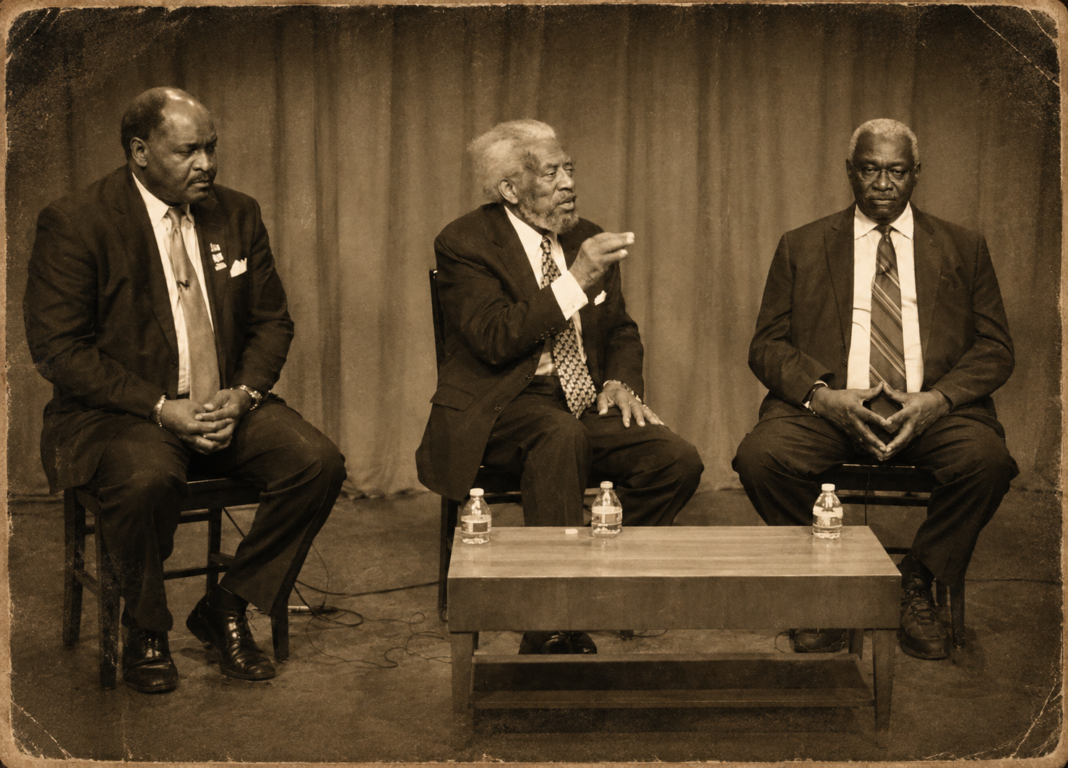

Editor’s note: This article draws from an archival Focus Springfield interview conducted 11 years ago, in 2015, by Darryl E. Moss. The discussion featured the late former State Representatives Benjamin Swan and Raymond A. Jordan Jr., along with Bud L. Williams, current state representative for the 11th Hampden District. Their conversation addressed civil rights, organizing, political leadership, economic development, and the unfinished work of community building.
In 2015, Darryl E. Moss brought together three Springfield leaders, former 11th Hampden District State Representatives Benjamin Swan, Raymond A. Jordan Jr. and State Representative Bud L. Williams, for a conversation about civil rights, social activism, political involvement, and the responsibilities of leadership.
Eleven years later, the conversation has gained additional weight. Swan and Jordan have since transitioned, while Williams serves as the current state representative for the 11th Hampden District.
The interview preserves a candid exchange among men whose political lives were shaped by Springfield’s civil rights movement. They discussed the work that takes place before a person enters elected office: organizing neighbors, responding to injustice, building institutions, mentoring younger people, developing economic opportunity, and preparing communities to act when opportunities arise.
What they offered was not nostalgia. It was a practical account of how community leadership is built.
Jordan described activism and political participation as closely connected.
“Social activism and political activism are first cousins,” he said. “Social activism helps to develop political understanding and political awareness.”
Jordan said people often begin organizing around a social issue but eventually recognize that changing conditions requires an understanding of political power. The work may begin with a complaint about a neighborhood condition, a school, a job, or police conduct. But lasting change, he said, often requires engaging elected officials, public institutions, and the political process.
Swan made a similar point. He said social activism was often the starting point for people who later chose to seek office or engage more directly in public policy. Movements develop when people identify a problem and begin asking what can be done about it.
“Social is the incubator,” Swan said. “It gets you involved to start paying attention to your environment and what is going on around you.”
Williams noted that some people prefer organizing because it allows them to speak plainly and act quickly. Politics can require negotiation and compromise. Still, he said, organizing and electoral work depend on one another. The community needs people who can raise issues publicly and people who can move those issues through government.
The discussion then turned to the Springfield civil rights movement of the 1960s.
Jordan said he was already active in workplace organizing as a machinist and shop steward when he began hearing about Swan’s work in the community. He had organized dances, talent shows, and other events, and Swan’s group recruited him to help raise money for the movement.
Jordan said he came to understand the seriousness of the work as he followed national news and watched the civil rights struggle unfold.
Swan became one of the central figures in Springfield’s organizing efforts. Before his tenure in the Massachusetts House of Representatives, he was active in civil rights advocacy and in the Springfield branch of the NAACP. He later helped establish a local chapter of the Congress of Racial Equality, known as CORE, after the 1963 March on Washington energized young people who returned to Springfield seeking a more direct approach to local problems.
CORE’s approach was rooted in nonviolent action. Members trained for demonstrations and organized around police brutality, tenant rights, welfare rights, fair housing, and other issues. Swan said the organization treated activism as serious work that required preparation, self-control, and a willingness to participate regularly.
The local movement gained urgency after the Octagon Lounge incident, which became a major flashpoint in Springfield.
Swan said the event reflected longstanding concerns about police brutality in Black neighborhoods. Residents had raised complaints before, he said, but the Octagon Lounge incident pushed many people to conclude that a stronger response was necessary.
Jordan was among those who witnessed the situation. He had been working a second shift and stopped at the Octagon Lounge with others from his carpool. He recalled seeing police officers using batons and people moving frantically around the area.
“It was really a traumatic experience for all of us,” Jordan said.
He said the official accounts that followed did not match what he had seen. The gap between his own experience and the public version of events deepened his commitment to activism.
Williams, who was in high school at the time, remembered hearing Swan and other local leaders speak. He was drawn to the movement and later joined young people who gathered on the steps of City Hall. He spent several nights there before police moved in.
Swan, Jordan, and other senior organizers told the younger people to go home when they believed the situation might become dangerous. Williams said the older activists remained and were later arrested.
For Williams, the experience provided an early lesson in the risks that civil rights work could carry. The people involved were not distant historical figures. They were students, parents, workers and families with jobs, children and obligations.
Jordan was married at the time, and his wife was pregnant. He was working while organizing but said it became difficult to maintain the balance. Meetings, demonstrations, and community activity often conflicted with work schedules. He said people in the movement sometimes felt that failing to show up meant letting down others who were depending on them.
Jordan recalled being arrested and beaten during the period. He also remembered the personal support that helped sustain the movement. His father and uncles helped bail people out of jail, including by putting up property to secure their release.
Swan said similar support came from a range of people in the community. Some of the individuals who contributed money for food and bail were not always viewed favorably by traditional institutions. But their support was real, he said, and it helped sustain activists during difficult moments.
The conversation also showed the influence Swan had on people around him.
Jordan recalled that Swan remained steady during tense confrontations with city officials and police. He remembered seeing Swan confront a police chief directly during a period of heightened tension in Springfield.
Swan said his time in Selma, Alabama, and his military experience had shaped his understanding of fear and sacrifice. He said that the civil rights movement required people to accept risk if they believed their cause was important enough.
Williams described Swan and Jordan as mentors. Before he became an elected official, he drove both men to events, helped with political gatherings, worked doors at fundraisers, and watched how they engaged with people. He said he was not initially focused on running for office. He learned by working in the background.
“I paid my dues,” Williams said.
Williams said that experience helped him understand the difference between wanting public recognition and doing the day-to-day work of leadership. It also gave him a close view of how political campaigns, community events, and organizing efforts functioned.
The men agreed that effective movements require more than anger.
Swan said that CORE members received nonviolence training because strong emotions can lead people to make poor decisions. He said activists needed discipline, preparation, and experienced leadership, particularly in moments involving police violence or public unrest.
People may be angry for legitimate reasons, Swan said, but anger alone is not a strategy.
The conversation also challenged a common assumption about the civil rights era. Swan said not everyone in Springfield’s Black community was involved in the movement, and not everyone supported the same tactics.
Some residents were uncomfortable with direct action. Others preferred legal strategies through the NAACP. There were disagreements about how quickly to move, how confrontational to be, and what risks were acceptable.
Swan said that organizers understood the importance of working inside established institutions as well as forming new ones. CORE members were encouraged to join the NAACP so they could participate in its work and help influence its direction.
The strategy reflected a broader lesson about civic power. Change requires people to participate in organizations, understand how decisions are made, build relationships, and develop a clear purpose.
Jordan cited Frederick Douglass’s observation that power concedes nothing without a demand. The group agreed that communities cannot wait passively for political opportunity or public attention. They must organize, define their interests, and insist on being heard.
The conversation also focused on the practical work of organizing.
Williams said that during the 1960s, organizers could fill the Dunbar Community Center with hundreds of people on short notice. A public meeting called in response to police brutality could draw two or three hundred people within hours.
Today, Williams observed, communication is easier, but mobilizing people can be more difficult.
Swan described the organizational work behind one major community meeting. While speakers addressed the crowd, he sat in the back of the room drawing a map of the Hill-McKnight neighborhood. He assigned people to distribute flyers, contact the media, notify the Dunbar Community Center, and go door to door on specific streets.
The organizers were not simply reacting. They were building a structure for action.
After the meeting, residents were instructed to meet at City Hall with blankets or sleeping bags. Swan said he expected perhaps 10 people to join them. Instead, the steps were filled.
The episode illustrated a point that ran through the entire discussion. Large public actions depend on careful planning, personal relationships, and people willing to take responsibility for specific tasks.
Williams described the balance between grassroots work and political work as one of the movement’s strengths. Community members worked in neighborhoods, mentored young people, organized residents, and responded to immediate concerns. Elected officials and political figures worked inside institutions. The goal was to bring those efforts together.
His concern was that too many people now want proximity to formal power without first doing the community work that creates trust and credibility.
The discussion then moved to economics.
Swan argued that civil rights cannot be separated from housing, education, employment, and wealth. He described racism as a web of interconnected systems. Where a family lives affects where its children attend school. Housing opportunities are shaped by lending, insurance, redlining, and income. Employment affects every other part of family life.
“You can’t talk about equality without talking about parity and economics,” Swan said.
Swan described how his children were transferred from DeBerry School to Dorman School after his family moved to Armory Village. His children had been receiving satisfactory marks, but they were held back after the transfer. He said a principal told him that DeBerry was “not quite up to our standards.”
The experience led him to examine the relationship between schools, neighborhood conditions, race, and opportunity more closely.
Jordan also emphasized economic development. He described one of his early efforts as organizing the Uplift Development Corporation, which aimed to understand development activity in Springfield and promote community benefit. The organization addressed economic development, cultural identity, racial awareness, and other issues connected to Black community development.
Williams spoke about the Black Harambee, a major Springfield event organized by Jordan, Mo Jones, Jay Griffin, and others. It drew nationally known performers, included a community parade, and brought large crowds together. It also created opportunities for vendors, workers and residents to earn income.
Williams described it as both a cultural celebration and an economic engine.
The men argued that Black communities should discuss wealth building more openly. Williams said conversations about saving, business ownership, employment, and creating assets are often missing from homes, churches, and community spaces.
He repeated a phrase that had stayed with him: “I want to sign my name on the front of the check instead of the back of the check.”
The point was not to diminish the importance of jobs. It was to expand the community’s expectations around ownership, entrepreneurship, and the ability to create employment for others.
Swan urged young people to prepare for economic opportunity before it arrives. He discussed major development planned for Springfield and said that young people interested in construction, union work, and skilled trades should pursue training early. He emphasized the importance of math, education, and meeting the requirements necessary to qualify for available jobs.
Waiting until contracts are already awarded or projects are underway, he said, is too late.
“You have to have a plan,” Swan said. “You have to have a plan and you have to work it.”
The interview ended with a discussion of progress and setbacks.
The men acknowledged that the country and Springfield had changed. Swan reflected on the impact of voter registration efforts, the Mississippi Freedom Democratic Party, and the increase in Black elected officials in states that had once systematically excluded Black voters.
Williams noted that the election of Barack Obama as president was made possible by generations of civil rights activism. He said that leaders such as Obama and former Massachusetts Gov. Deval Patrick stood on the shoulders of people such as Swan, Jordan, John Lewis, Jesse Jackson, and countless others who built the foundation for greater political participation.
But the three men also cautioned against treating progress as inevitable.
Swan said that people who oppose change often have plans of their own. Communities seeking equality and opportunity must be equally prepared.
They discussed how racial discrimination can take different forms over time. In earlier decades, Black applicants might have been told directly that they were not qualified for certain jobs. Today, people may be told they are overqualified, even after earning degrees, gaining experience, and meeting the stated requirements.
Williams said conversations about race remain necessary, even when they are difficult. But he also stressed that conversation must lead to action and planning.
The challenge, he said, is to bring people together, develop common goals, and create a practical route forward.
The conversation between Swan, Jordan, and Williams is an account of a generation that understood leadership as a long process. It began with organizing, preparation, and service. It required people to listen, learn, take risks, and accept responsibilities that did not always bring recognition.
Their stories are not simply records of the past. They provide a clear framework for the present.
For anyone seeking to lead, organize, build a business, serve in government, or strengthen a neighborhood, the lessons remain direct. Learn the history. Do the groundwork. Participate in institutions. Build relationships. Prepare for opportunity. Develop a plan. Work the plan.
The standard established by Benjamin Swan and Raymond A. Jordan was not defined solely by the offices they held. It was defined by their connection to the people, their willingness to confront difficult conditions, and their commitment to producing results that improved the lives of the community.