


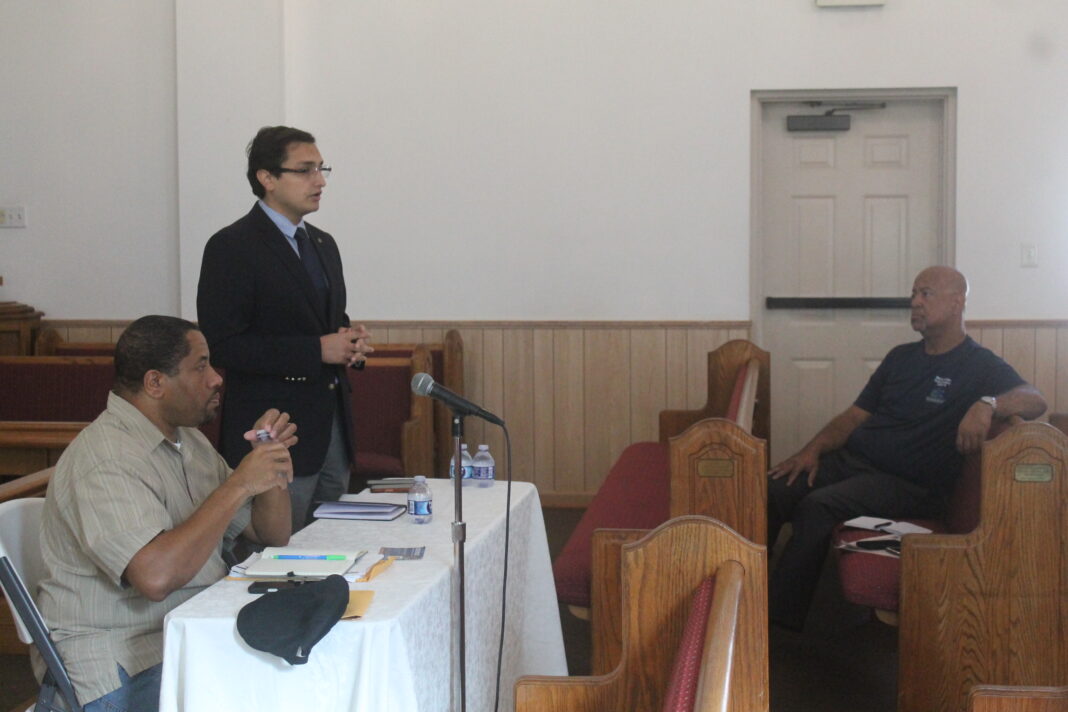

Transportation officials discuss infrastructure needs, proposed projects, and possible funding ahead of the Nov. 3 vote.
DOUGLASVILLE, Ga. — Douglas County residents gathered Saturday for a District 3 town hall on the proposed Transportation Special Purpose Local Option Sales Tax, or T-SPLOST, hearing directly from county transportation officials about roadway needs, potential projects and how the proposed tax could fund future improvements.
The Sept. 26 meeting was hosted by District 3 Commissioner Martin Raxton. Suleman Rana, M.S., P.E., managing director of the Douglas County Department of Transportation, delivered the presentation and answered residents’ questions.
Officials characterized the event as an informational session, rather than a campaign event, intended to help residents understand the proposal before the Nov. 3, 2026, ballot referendum.
“Our goal is to educate, and if you choose to approve, it’s to deliver on the promises and the capital investment that we have committed to,” Rana told attendees.
Funding Needs and Growth
Rana said Douglas County is expected to continue growing over the coming decades, citing regional projections that anticipate roughly 25 percent growth during the next 20 to 25 years.
At the same time, he said construction costs have increased significantly since the COVID-19 pandemic, with the county experiencing more than 40 percent inflation in the construction industry.
“Our needs are much greater than our existing funding,” Rana said. “To be able to meet the baseline conditions of our infrastructure, we need additional funding sources to fund it.”
T-SPLOST would provide one potential revenue source for transportation projects. Unlike a property-tax increase, the sales tax would also be paid by shoppers traveling through or visiting the county.
Rana described Douglas County as a major transportation corridor connecting communities west of Atlanta with the broader metropolitan region. He estimated that between 10 million and 15 million vehicles travel through the county each month, with many of those vehicles passing through rather than beginning or ending their trips in Douglas County.
“It’s your decision,” Rana said. “Our goal is to educate.”
Resurfacing Backlog
Road resurfacing emerged as one of the proposal’s largest areas of need.
Rana said the county faces an estimated 30-year backlog in resurfacing work, driven in part by years of deferred investment. The proposed project list includes more than 100 miles of roadway resurfacing, along with roadway improvements, intersection work, pedestrian safety projects, and other infrastructure investments.
“If you don’t address the problem today, it only gets worse tomorrow and it only gets more expensive,” Rana said.
He also noted the scale of the county’s transportation responsibilities. According to Rana, approximately 25 to 30 Department of Transportation employees are responsible for managing and maintaining about 800 miles of roadway.
Matching State and Federal Funds
Residents also asked how local T-SPLOST revenue could affect Douglas County’s ability to obtain state and federal transportation funds.
Rana explained that many state and federal transportation programs require local governments to provide matching funds, although the required local share differs by program. He cited Lee Road as an example of a project in which local funding helped the county leverage a substantially larger amount of state and federal transportation dollars.
“Local match has been a great tool for us to extend our dollars,” Rana said.
The proposed T-SPLOST project plan includes $1 million for Department of Transportation grants and local matching funds.
Dirt Roads, Sidewalks, and Transit
The town hall also addressed transportation needs beyond major road construction.
Rana said Douglas County still has approximately 35 miles of dirt roads. Funding limitations, he said, affect how quickly the county can address those roads.
The proposed project list includes a Sidewalk Connectivity Program, pedestrian-safety and traffic-calming improvements, and funding for Connect Douglas, the county’s Dial-a-Ride and microtransit service.
When asked whether public transportation could benefit from T-SPLOST funding, Rana said the proposal includes approximately $3 million for transit. He said those funds could help support expanded service while the county continues evaluating paratransit, microtransit and transportation-voucher programs.
What Comes Next
The District 3 town hall was among several public discussions expected as Douglas County prepares for voters to consider the proposed T-SPLOST referendum on Nov. 3.
The county’s current project plan includes proposed investments in resurfacing, road widening, intersections, sidewalks, trails, traffic signals, pedestrian safety, and transit.
Questions remain about the county’s public estimates of potential T-SPLOST revenue and how projected collections compare with the cost of the proposed project list. Those questions warrant additional review as voters consider the measure.
For now, Saturday’s meeting gave residents an opportunity to hear from county transportation leadership and raise questions about what the proposed tax could mean for roads, mobility, and long-term infrastructure needs across Douglas County.