


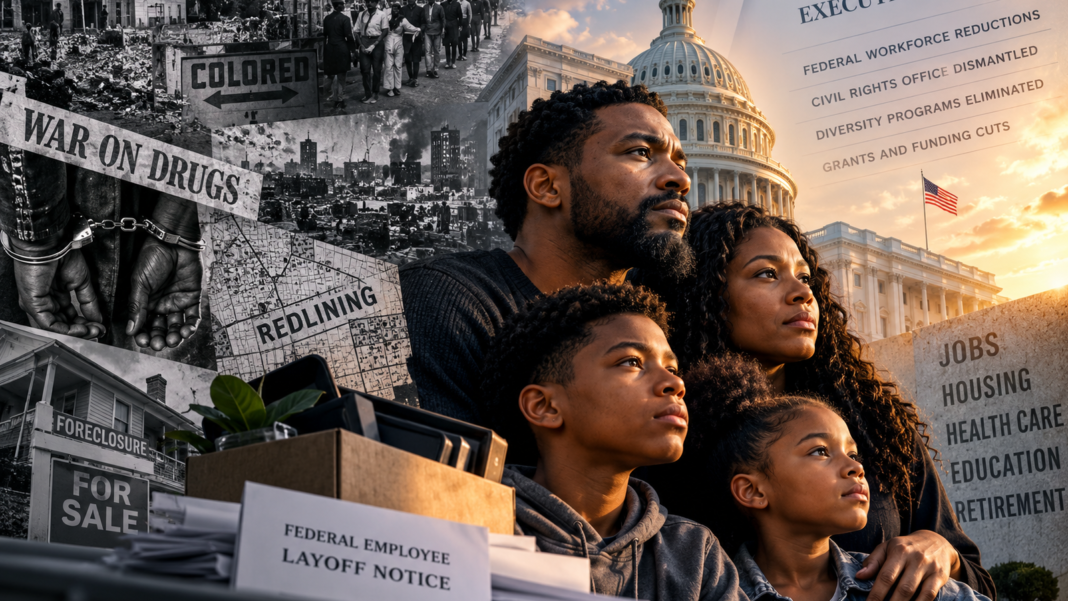

America’s attack on Black economic security travels through policy—and Black families cannot afford to wait for a confession before preparing.
Opinion | Darryl Moss for The Metro Record
America has declared economic war against Black people.
The declaration does not arrive in those words. It arrives as an executive order, a workforce reduction, a dismantled civil-rights office, a campaign against diversity or a public list identifying professionals whose work has suddenly become politically unacceptable.
The language is administrative. The consequences are personal.
A mortgage becomes harder to pay. Health coverage becomes uncertain. A retirement account becomes an emergency fund. A child’s college plans are postponed. An elderly parent takes extra shifts because a grown child’s professional career has been interrupted.
That is not merely a disagreement over the size of government.
It is a threat to the foundations of Black American stability.
For Black readers, this is notice to examine what is happening and prepare. For white readers, it is an invitation to stop measuring racism exclusively by whether someone announces a racist intention—and start examining the decisions that determine whose lives become less secure.
Policy is the architecture of everyday life
We often discuss policy as though it belongs to politicians, attorneys and people paid to attend meetings.
But policy helps determine whether your family can buy a house, whether your employer can discriminate against you, whether your child’s school has adequate resources and whether you can afford care when someone becomes ill.
It shapes the difference between having income and building wealth. Between working until you choose to retire and working until your body gives out. Between leaving your children an asset and leaving them a financial emergency.
Consider housing.
The Federal Housing Administration helped institutionalize racial discrimination in mortgage lending. Its underwriting guidance treated Black occupancy as a threat to property values and recommended racially restrictive covenants. Redlining restricted access to credit even when individual borrowers were qualified.
Those decisions did not simply express prejudice. They organized opportunity.
One family gained access to a home and the possibility of accumulating equity. Another was denied that pathway. Over time, unequal access to credit and investment helped reproduce unequal economic conditions.
Then America looked at the resulting inequality and asked why Black families had not accumulated more.
That is what happens when policy disappears from the explanation and personal responsibility is made to carry the entire story.
Black independence has been restricted before
After emancipation, Southern governments enacted Black Codes that constrained the freedom slavery’s abolition was supposed to secure.
These laws required labor contracts, used vagrancy provisions to punish unemployment and restricted economic independence. Mississippi prohibited Black people from renting or leasing rural land. South Carolina imposed special licensing requirements on Black workers entering certain occupations outside agriculture and domestic service.
The message was clear: freedom would not necessarily include the power to choose how to work, negotiate or build an independent life.
The law was not standing outside racial domination. It was helping administer it.
In Tulsa, Oklahoma, white rioters destroyed homes, businesses and institutions in Greenwood in 1921, leaving 35 city blocks in ruins. Afterward, a city fire ordinance effectively obstructed rebuilding. Attorney B.C. Franklin successfully challenged it.
Violence destroyed what residents had built. An ordinance threatened their recovery.
These histories are not interchangeable. Their connection lies in the recurring struggle over whether Black Americans can establish security—and keep it.
Sometimes the instrument is a mob. Sometimes it is a statute. Sometimes it is a decision issued on official letterhead.
The form changes. We still have to examine the function.
The War on Drugs taught us to follow the consequences
The War on Drugs was presented as a campaign against a public threat.
Its enforcement produced a deeply unequal burden. The Sentencing Project reports that Black and white Americans use illicit drugs at roughly similar rates, yet Black Americans accounted for more than one-quarter of drug arrests in 2019 while representing approximately 14% of the population.
The consequences reached beyond arrest or imprisonment. Criminal-system involvement could restrict access to employment, housing and civic participation, extending punishment into the conditions necessary to rebuild a life.
The lesson is not that every present-day policy is identical to the drug war.
It is that a campaign’s official title does not tell us everything we need to know about its operation.
We must follow what it does to people.
Today, the campaign against diversity, equity and inclusion requires that same scrutiny: what is being dismantled, who is losing protection, and whose household is absorbing the cost?
What the employment numbers are telling us
Federal employment has been an important pathway into the Black middle class, offering comparatively stable work, benefits and protections against discrimination. The Economic Policy Institute warned that attacks on federal agencies threatened both Black workers and the communities those agencies serve.
The consequences are no longer merely hypothetical.
A Washington Post analysis estimated that Black federal employment fell 20% when comparing January–September 2026 with the same months in 2024. White federal employment declined about 4%. Hispanic employment increased approximately 6%, and Asian employment increased approximately 1%.
These are survey-based net employment estimates, not a count of individual anti-DEI dismissals. They document a racial disparity in employment change; they do not supply the explanation for every departure.
But they demand an explanation.
Other groups doing better does not answer whether Black workers are being subjected to discrimination. Anti-Black racism does not require identical treatment of everyone else.
And saying that Black workers were concentrated in affected agencies describes their exposure. It does not absolve the decisions about which agencies and functions to target.
An organizational chart is not an alibi.
Harris is an example of the danger—not the boundary of the story
Dia Harris left a higher-paying corporate career to work at the Administration for Children and Families, the agency overseeing Head Start—a program that helped him as a child.
Despite top performance ratings, he was placed on leave after President Donald Trump returned to office and eventually fired. The American Accountability Foundation then identified him on its “DEI Watchlist,” publishing his photograph, salary and employment history. About two-thirds of the 93 workers named were Black.
Harris told The Washington Post that a recruiter warned him the listing made him unacceptable to a prospective employer reliant on federal contracts.
That is the danger of public political targeting: the injury can follow a worker beyond the position that was eliminated.
After more than 560 applications, Harris was working at a grocery store for $16 an hour and holding a second job as an overnight concierge. His 71-year-old mother took extra shifts to help cover expenses. He drew from retirement savings to pay his mortgage and bills.
There is dignity in his work. There is no dignity in celebrating the circumstances that forced his household into distress.
Yet when asked about prolonged unemployment among watchlisted workers who had left government, foundation president Tom Jones wrote that, if the Post’s reporting was accurate, “we cannot overstate our joy.”
That is not a private thought we must somehow divine.
It is an expressed response to other people’s economic hardship.
The injury reaches the children
Harris’s household is not the only example.
ProPublica reported on Quay Crowner, a veteran federal manager whose participation in management-encouraged diversity training became associated with her removal, although she said her current job was not a DEI position.
It also documented Sherrell Pyatt’s experience after the Department of Homeland Security dismissed nearly all 150 employees in its Office for Civil Rights and Civil Liberties. Losing her income raised fears about her family’s mortgage and the opportunities available to her three daughters.
This is where “workforce policy” becomes childhood.
A parent loses income. A child loses an activity, an educational opportunity or the security of knowing the household can weather an emergency.
A family spends savings rather than building them. An older relative delays rest. The next generation inherits a smaller cushion.
Calling these consequences administrative does not make them less consequential.
We do not need access to anyone’s mind to prepare
Evidence matters. So does the question the evidence is being asked to answer.
Assigning discriminatory intent to a particular person requires support. But Black families do not need a final ruling about someone’s private motives before recognizing that their economic position is becoming more vulnerable.
A household cannot tell its mortgage company it is waiting for litigation to establish why its income disappeared.
Nor should racism be defined so narrowly that the only acceptable evidence is a confession.
Policies deserve examination through their language, their targets, their implementation, their historical setting and their consequences. An official claim of neutrality is part of that examination—not its conclusion.
We can demand accuracy without requiring injured people to establish everything before being allowed to name anything.
Black parents need plans that reach beyond employment
The response must include defending our rights. Public employment and equal treatment are not gifts from white America. They are matters of citizenship.
But defending those rights and reducing our vulnerability are not competing obligations.
Black parents should be able to discuss economic preparation with their children in terms broader than “get a good job.”
Which skills travel across employers? Who controls access to the profession? How is the work funded? What does it take to own an enterprise rather than depend entirely on employment? Where can cooperation create opportunities a household cannot build alone?
Those questions do not guarantee security. They help families think beyond a single gatekeeper.
Practical preparation should include:
- Mapping household exposure to one employer, industry or government funding source.
- Maintaining professional relationships beyond the current workplace.
- Identifying transferable skills and realistic opportunities for additional income, without treating exhaustion as a financial strategy.
- Preserving employment records and seeking qualified assistance when discrimination or unlawful dismissal may be involved.
- Teaching children how ownership, contracts, credit and public decisions shape economic choices.
Not every family has money to invest. Not every parent should become an entrepreneur. Advice that ignores those realities simply repackages structural harm as individual failure.
That is why community institutions matter.
Black businesses, churches, professional associations, colleges and civic organizations should develop referral systems, apprenticeships, shared services and credible pathways to customers, training and capital.
The objective is not another motivational event.
It is more capacity under our own control.
White America must do more than express concern
White readers should understand what is being asked of them.
Do not demand that Black families become destitute before accepting that a policy warrants scrutiny.
If you employ people, evaluate their qualifications rather than treating political targeting as a reason to exclude them.
If you hold office, demand demographic transparency and explanations that withstand examination.
If you support a campaign against discrimination, examine whether its actual operation is protecting opportunity or narrowing it.
Opposition to racism must affect decisions about employment, ownership, investment and institutional power.
Otherwise, it remains a sentiment that costs nothing and changes little.
We cannot keep spending tomorrow to survive today
The warning is not that Black achievement is pointless.
It is that achievement without durable protection can be made precarious—and that we must build more ways to defend it.
America has repeatedly told Black people to work, save, qualify and build. Our history also records the barriers erected against those efforts and the destruction of what we managed to establish.
We should not have to relearn that history through every generation’s financial emergency.
The task now is to recognize the threat, challenge the decisions producing it and strengthen the institutions that can help our families withstand it.
Harris and the other displaced workers are not the entire story. They show us where the story enters a home.
Policy becomes a missing paycheck. A missing paycheck becomes depleted savings. Depleted savings become fewer choices for the children.
That is why this is a fight over Black American stability.
And why preparation cannot wait until the people exercising power agree with our description of what they have done.