


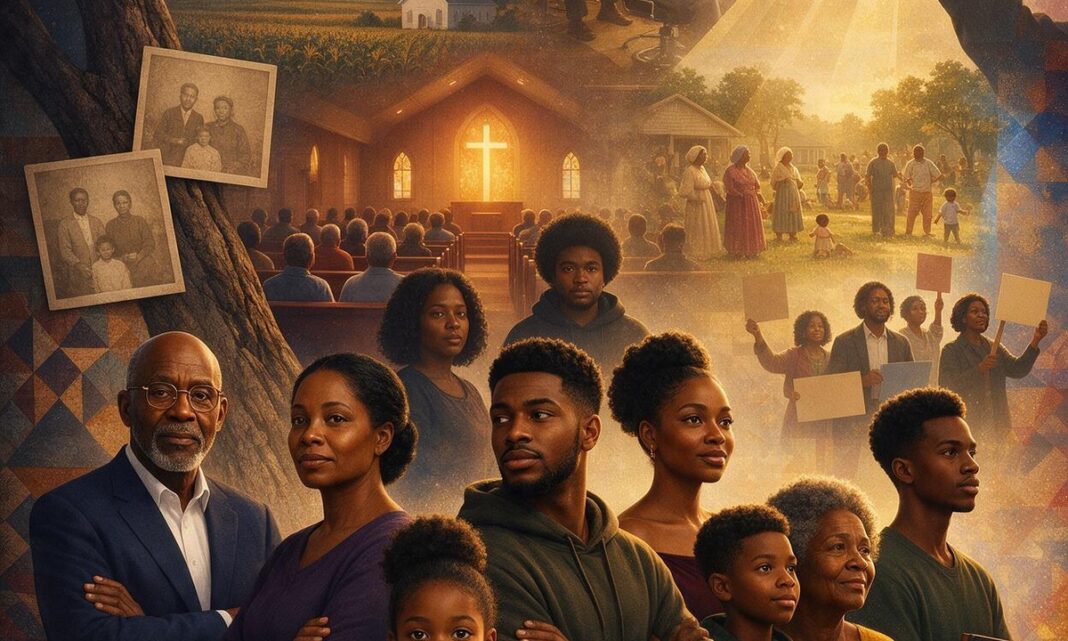

“In America, Blackness has never been incidental. It is foundational.” This is not an opinion. It is evidenced in policy, culture, and institutions. For Black Americans, understanding and affirming that identity is more than cultural pride. It can be a path toward wholeness, healing, and collective resilience.
A Pew Research Center study found that 76% of Black adults in the United States say being Black is extremely or very important to how they see themselves. That rises to 83% among Black elders, many of whom experienced segregation as lived reality rather than distant history. These figures reflect a deeper truth. For many Black Americans, race is not a surface characteristic. It is a compass.
Reclaiming Self Through History
For Black Americans, identity is shaped not only by skin tone but also by the enduring weight and wonder of history. Nearly six in ten Black adults say they know their ancestors were enslaved in the United States. Those who regard Blackness as central to their identity are more likely to seek that knowledge through family stories, oral traditions, genealogical research, and DNA testing.
This is not morbid curiosity. It is ancestral literacy.
The reclamation of history is personal, political, and necessary. In a nation where Black contributions are too often treated as footnotes rather than headlines, knowing one’s lineage becomes an act of resistance. It affirms that Black Americans have always been more than the limits this country placed on them or the stories it chose to tell.
Collective Fate in America
Identity is not only individual. It is collective. More than half of Black adults say that what happens to Black people nationally affects their own lives. That is not symbolism. It is sociology.
Racism is systemic. In a society that criminalizes skin, marginalizes voices, and monetizes trauma, harm done to one part of the community reverberates through many others.
This is not about victimhood. It is about visibility. It is the unspoken bond formed in barbershops and protest lines, in Juneteenth celebrations, and in church pews. It is the recognition that the killing of George Floyd was not only a tragedy but also a warning. It is the understanding that housing discrimination remains a practice, not simply a remnant of the past. It is the refusal to accept the silencing of Black voices in school curricula as a neutral educational choice when it functions as erasure.
Mental Health and Self-Naming
To affirm one’s Blackness is to insist on one’s humanity in a society that has often denied it. Research has linked a positive and affirmed racial identity with stronger mental health outcomes among Black Americans. It can cultivate self-worth in the face of dehumanization, build resilience amid adversity, and restore a sense of agency in a country that has too often framed Blackness as a burden.
That restoration also includes language. The term “Soulaan,” blending “Soul American” and “Autochthonous American,” emerged through online spaces such as TikTok, where Black youth claimed the authority to define themselves. The term seeks to name a particular lineage and historical experience, especially that of Black Americans descended from U.S. slavery.
For supporters, this is not division. It is a definition. It is self-naming, which is a powerful form of liberation in a society that has repeatedly tried to name, classify, and redefine Black people from the outside.
The Diversity Within Blackness
Recognizing Black identity as central does not mean treating Black America as uniform. Black America is not a monolith. It includes people from Brooklyn and rural Louisiana, first-generation immigrants in Boston, and multigenerational descendants of enslaved people and maroon communities in Mississippi.
Symbols such as the FBA Nation Maroon Flag, with its torch and five stars, reflect efforts to honor regional histories of resistance across Virginia, the Carolinas, Florida, Mississippi, and Louisiana. Each place holds its own history of rebellion, survival, and freedom seeking.
There are differences across generations, political views, regions, class backgrounds, immigration histories, and cultural traditions. Yet even amid disagreement, there remains a shared understanding that race is not optional for Black Americans. It is structural.
Blackness as Blueprint
The assertion that race is central is not an indictment of Black people. It is an indictment of the nation that made race so consequential. Still, out of that imposition, Black Americans have forged an identity that functions as both shield and sword. It is survival, culture, memory, and clarity.
To be Black in America is to be connected to a past that built the nation and to a present that too often refuses to honor that labor. It is also to be connected to elders and ancestors, neighbors and strangers, Harriet and hip hop.
It is to say, “I am here.” I know who I am. And I will not be erased.