


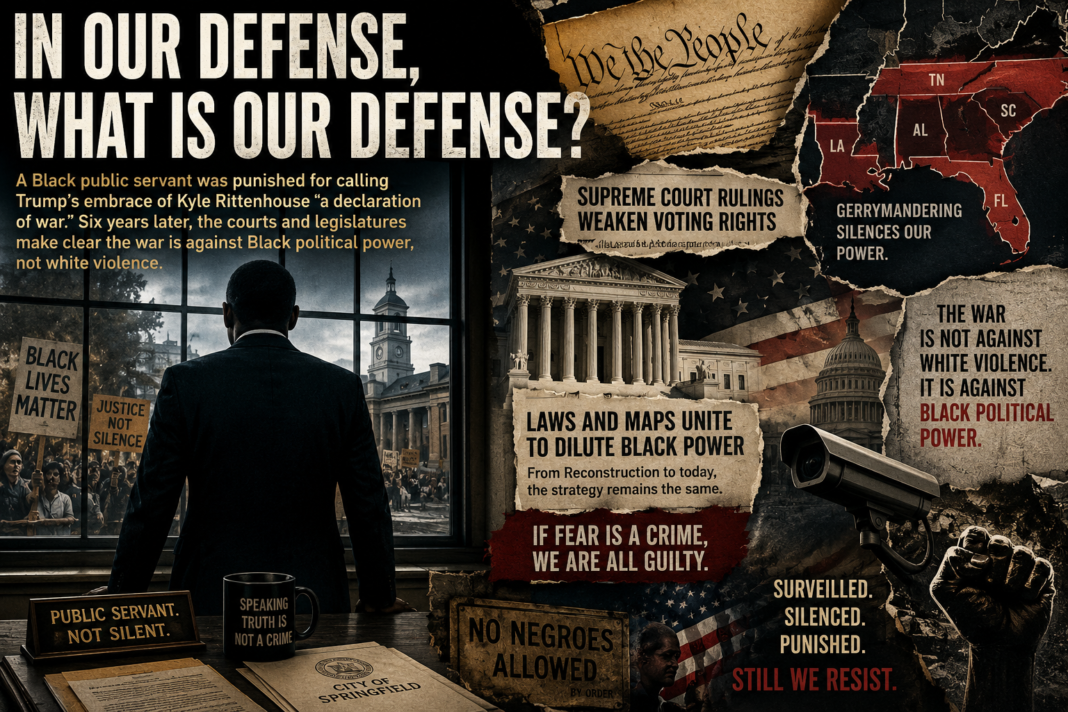

A Black public servant was punished for calling Trump’s embrace of Kyle Rittenhouse “a declaration of war.” Six years later, the courts and legislatures make clear the war is against Black political power, not white violence.
By Darryl E. Moss
Editor’s Note:
This article is not about, nor is it an attack on, Domenic Sarno as an individual. In the larger sense, he is insignificant, just another spoke in a system that consistently reads Black voices as threats and punishes Black people for naming danger out loud. This piece is about something bigger: sounding the alarm and preparing, together, to build the power and protection Black children and families will need to survive and thrive in the years ahead.

For years, I have reflected on a statement that changed the course of my professional life and forced me to confront an uncomfortable question about race, political speech, and power in America.
In 2020, during one of the most volatile racial and political moments in recent history, I shared a news article about then President Donald Trump defending Kyle Rittenhouse, the teenager who killed two people during a Black Lives Matter demonstration in Kenosha. I wrote, “This is equal to a declaration of war…but this is America! A sundown, Sunrise ass country.” Then, tagging a friend, I added, “Yo…grab the rifles.”
It was the language of alarm and bitter irony, rooted in the long history of sundown towns where Black people understood that after dark, their very presence could be met with violence. It was not a threat. It was not a plan. It was a Black man, working inside government, trying to name how it feels when the president of the United States publicly sympathizes with a white vigilante who killed protesters and suggests he acted in self-defense. In a “Sundown, Sunrise ass country,” “grab the rifles” was a way of saying, “Understand what time it is.” Recognize the danger. This is how bad it could get.
I was not some anonymous commenter barking from the sidelines. I was a Black man working inside City Hall, responsible for speaking on behalf of a municipal government that has long struggled with issues of policing, accountability, and racial equity.
D.Moss
That post ultimately contributed to the termination of my employment with the City of Springfield under Mayor Domenic Sarno. I was not some anonymous commenter barking from the sidelines. I was a Black man working inside City Hall, responsible for speaking on behalf of a municipal government that has long struggled with issues of policing, accountability, and racial equity. A Hampden County jury has since found that the mayor and the city illegally retaliated against me for that speech and awarded damages for the violation of my civil rights. Yet even that verdict cannot fully answer the question that has lingered in my mind. What, exactly, are Black people in Springfield allowed to say in our own defense before those in power decide we have gone too far?
If a Black public servant, reacting to a president defending a young man who killed two people at a protest over the shooting of a Black man, cannot call that posture dangerous without risking his livelihood, then what is the acceptable vocabulary for Black fear? When a president declines to condemn the shootings, worries aloud about whether the shooter is “in very big trouble,” and later welcomes him as a kind of culture war mascot, the message to many Black Americans is unmistakable. Some people’s fears justify lethal force. Our fears are treated as overreaction or incitement.
Springfield is not separate from that history. This is a city where police misconduct cases and racially charged incidents have repeatedly ended up in court, where the City Council has sued the mayor over civilian oversight of the police department, and where those who push hardest for reform are often painted as the problem instead of the people trying to solve it. My case is one chapter in a longer story about who can safely name abuse or danger in this city, and who gets punished for it.
After that moment in 2020, the country’s political trajectory began to answer my question in ways I did not predict in detail but recognized in spirit. At the federal level, Supreme Court decisions had already weakened the Voting Rights Act, removing preclearance and making it harder to stop discriminatory laws before they took effect. More recently, the Court went further, striking down a Louisiana court-ordered majority Black district and dramatically narrowing when race can be considered to protect Black voters. That ruling immediately triggered mid-decade redistricting moves in Alabama, Tennessee, Louisiana, Florida, South Carolina, and other states. Lawsuits and legal analyses describe these new maps as diluting Black political power, eliminating majority Black or Black opportunity districts, and locking in white Republican dominance despite large Black populations.
In Florida specifically, new congressional maps pushed through under Governor Ron DeSantis are being challenged as unconstitutional partisan and racial gerrymanders that dismantle districts where Black voters had a meaningful chance to elect candidates of their choice. Voting rights groups argue these maps directly undermine the Fair Districts Amendments that Florida voters adopted to prevent exactly this kind of racial dilution. Historically, this fits a familiar pattern. After Reconstruction, states like Florida used legal tools such as white primaries, poll taxes, literacy tests, and felony disenfranchisement to eliminate Black votes without ever writing “no Black people can vote” into statute. It was a deliberate strategy to neutralize Black political power while maintaining formal compliance with the Fifteenth Amendment. When you step back, that looks very much like a sustained legal and legislative offensive aimed not at particular individuals but at the political capacity of Black communities.
Now, in Alabama, we hear a Republican House Speaker publicly say he hopes the Supreme Court will overturn Amendment 14. That is the amendment that established birthright citizenship, guaranteed equal protection, and required due process before a state could deprive anyone of life, liberty, or property. Those three guarantees, the citizenship clause, the equal protection clause, and the due process clause, are not abstractions for Black people. They are the frail legal scaffolding that replaced Dred Scott’s declaration that Black people had no rights, which the white man was bound to respect. Without the Fourteenth Amendment, states could openly revive something like the Black Codes, passing laws that dictate where Black people can live, work, own property, or move, with federal courts largely powerless to intervene. Federal civil rights enforcement would collapse back into a patchwork of state discretion. Birthright citizenship itself would be up for grabs.
We have seen this movie before. After Reconstruction, when federal troops withdrew and the Supreme Court narrowed the reach of the Fourteenth Amendment in decisions like the Civil Rights Cases and United States v. Cruikshank, white mobs who massacred Black citizens walked free because the Court said the amendment only applied to state action, not private terror. The result was predictable. Jim Crow laws made segregation and discrimination legal; Black officeholders were driven out; lynching and racial terror soared with no real legal recourse; and Black Americans were shoved back into second-class citizenship in everything but name. When people talk casually today about overturning the Fourteenth Amendment, they are flirting with that same abyss.
There is a bitter irony here. The Fourteenth Amendment was specifically designed to enable race-conscious programs supporting newly freed Black Americans, including the Freedmen’s Bureau, assistance for Black Civil War veterans, and other explicitly Black-focused efforts to deliver land, education, healthcare, and legal protection to formerly enslaved people. The same Congress that wrote equal protection into the Constitution also funded institutions aimed directly at Black uplift because it understood that equality on paper would mean nothing without remedies targeted to those who had been enslaved. Today, conservative legal strategists invoke that same amendment to dismantle programs benefiting Black communities, claiming colorblindness, and to argue that government may never consider race, even when trying to repair racial exclusion.
That inversion is not an accident. A network of conservative legal organizations and think tanks has spent years developing a colorblind Constitution doctrine and mapping out how to turn the Fourteenth Amendment from a tool of racial justice into a weapon against race-conscious remedies. Activists like Edward Blum, who helped gut the Voting Rights Act and affirmative action, have openly pursued a litigation strategy to reinterpret equal protection as a ban on almost any policy that acknowledges race. State-level moves, including Alabama’s hostility to the Fourteenth Amendment and mid-decade redistricting in multiple Southern states, do not appear out of nowhere. They follow a playbook.
If that strategy succeeds, the implications cascade. Enforcement of what is left of the Voting Rights Act collapses, because you cannot prove racial discrimination in maps if courts refuse to let you talk about race. Affirmative action in education and employment has already been gutted. Targeted programs for historically Black colleges and universities, Black maternal health, or minority-owned businesses become constitutionally suspect. Any policy that names racial disparity can be challenged as an unconstitutional racial preference. Legal scholars describe this as a shift from an anti-subordination view of equality, where law confronts racial hierarchy, to an anti-classification view, where the only sin the Constitution recognizes is mentioning race at all.
This brings me back, again, to 2020. In that year, Trump publicly refused to condemn Kyle Rittenhouse, focused on whether Rittenhouse was in very big trouble, suggested he acted in self-defense, and later welcomed him at Mar-a-Lago. Those gestures came in the context of nationwide protests over the police shooting of Jacob Blake and broader Black Lives Matter demonstrations. From a Black vantage point, especially from someone working inside government, it was reasonable to interpret that posture as the state signaling tolerance for vigilante violence in response to Black-led protest and alignment with those who frame Black protest as a threat rather than a plea for safety and rights.
Paired with what has followed, the dismantling of voting protections, the stripping of Black districts, and an increasingly aggressive colorblind constitutional rhetoric used to attack race-conscious remedies, the sequence looks less like isolated policy moves and more like stages of a broader campaign. In 2020, I said Trump’s embrace of Rittenhouse felt equal to a declaration of war and reached for the language of a Sundown, Sunrise ass country because it seemed we were crossing a line where Black lives and Black protests could be treated as open targets. In 2026, courts and legislatures are rewriting the rules of democracy and the meaning of equality in ways that repeatedly weaken Black votes, Black districts, and Black-focused remedies.
So I put the question to you plainly. If this is not a kind of war on Black political power, if it is not a coordinated campaign when courts narrow the Voting Rights Act, legislatures rush to erase Black districts, and local officials in cities like Springfield punish Black public servants for naming the danger, then what is it? What language honestly describes a strategy that returns, again and again, to the same targets: Black districts, Black votes, Black-led protests, and even the very constitutional tools created after slavery to defend Black citizenship?
If the question in this piece is whether my statement was correct, whether a legislative and legal war was being prepared against Black people, a fair answer is this. I did not predict every tactic or every court case. But I did correctly perceive that a political movement willing to valorize armed response to racial justice protest would also be willing to use law and legislation to contain, blunt, and roll back Black political power. Subsequent redistricting battles, voting rights rollbacks, and open attacks on the Fourteenth Amendment strongly support the view that a coordinated legal and legislative offensive against Black political influence was indeed being prepared and is now underway.
This is not a plea for special rules. It is a demand for honest language. Black Americans have always had to argue not just for our rights but for our right to describe reality as we live it. From Reconstruction to Jim Crow to the present fight over redistricting and the meaning of equal protection, our survival has depended on the ability to name what is being done to us and to organize in response. Springfield cannot control what the Supreme Court does or what Alabama’s legislators say about the Fourteenth Amendment. But we can decide, right here, whether this city is a place where Black people are punished for sounding the alarm or a place where their warnings are finally taken seriously.