


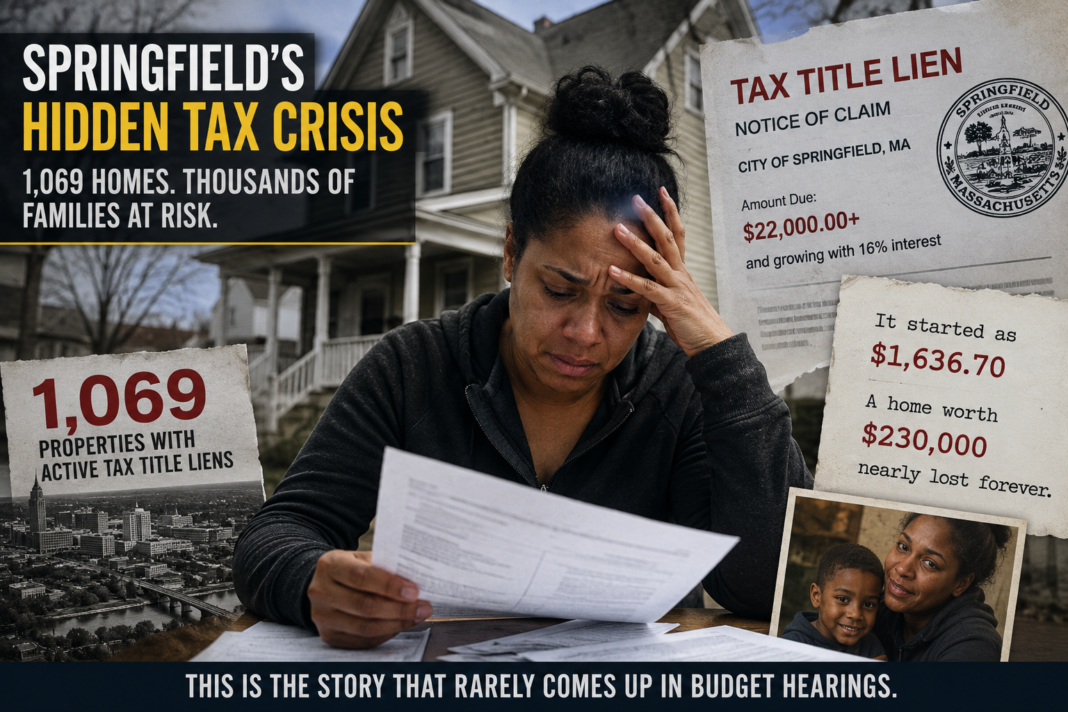

The city’s own public database lists 1,069 homes under active tax title liens. One Springfield woman nearly lost a $230,000 home over a debt that started at $1,636. This is the story that rarely comes up in budget hearings.
SPRINGFIELD, MA — There is a list the City of Springfield publishes on its website but almost never discusses publicly. It is a database of properties on which the city has placed formal legal claims, known as tax title liens, for nonpayment of property taxes.
As of May 2026, that list contains 1,069 properties.
Each entry represents a family or property owner who fell behind on taxes, often by small amounts at first, and now finds themselves locked in a compounding debt situation that can end in the permanent loss of their home. Some listings in the database show unpaid taxes going back 45 and even 68 years. All are in various stages of a legal process that can ultimately strip an owner of everything they have built.
This is Springfield’s hidden tax crisis, one that receives almost no attention in the annual budget debates even as the city celebrates balanced books and fiscal milestones.
16 Percent Interest and the Debt That Never Stops Growing
Under Massachusetts General Laws Chapter 60, when a municipality places a tax title on a property, it begins charging 16 percent annual interest on the unpaid balance. That rate, higher than nearly any consumer loan available to homeowners, is what turns a modest tax debt into an insurmountable financial burden.
To pursue collection, Springfield employs Revenue Services, LLC, a private tax collection firm based in Hamden, Connecticut. Homeowners who have fallen into tax title must contact Revenue Services directly for payoff amounts, adding a layer of private profit to what is already a painful and confusing process.
Massachusetts’s Chapter 14 of the Acts of 2024 reduced the interest rate for new tax title entries recorded after November 1, 2024 to 8 percent. But for the hundreds of Springfield properties already in tax title before that date, the 16 percent rate continues to apply to all accumulated debt.
Ashley Mills: The Face of an Invisible Crisis
No case illustrates the human cost of Springfield’s tax-title foreclosure system more clearly than that of Ashley Mills, a Springfield homeowner who came within a court ruling of losing everything she inherited.
In 2016, Mills fell behind on property taxes by $1,636.70. It is a sum that could happen to anyone facing an unexpected expense, a medical bill, or a period of unemployment. Over the following years, Mills entered into payment agreements with the city. But the 16 percent interest rate and accumulated fees meant she could never fully catch up.
By 2023, her original debt of $1,636 had grown to approximately $22,000. The city filed a Motion for Judgment of Foreclosure, which under Massachusetts law as it then stood would have allowed Springfield to take Mills’ home entirely. The home, which Mills shares with her young son and her disabled mother and which she inherited from her grandmother, was valued at approximately $230,000.
Under the city’s proposed foreclosure action, Springfield would have collected not just the $22,000 owed but the entire property, keeping more than $200,000 in equity that rightfully belonged to the Mills family.
The Pioneer Public Interest Law Center, Greater Boston Legal Services, and the law firms of Morgan Lewis and Greenberg Traurig stepped in on Mills’ behalf and challenged the action in Hampden County Superior Court.
On April 18, 2024, Judge Michael Callan issued a ruling in Ashley M. Mills v. City of Springfield that legal advocates called a landmark. The court found that the Massachusetts tax title foreclosure statute, as applied in cases where the homeowner’s equity far exceeds the tax debt, is unconstitutional. Because the statute contained no mechanism for an owner to recover the value of their property above the amount owed, the court held that the city’s retention of surplus equity violated the Takings Clause of Article 10 of the Massachusetts Declaration of Rights and the Fifth Amendment to the United States Constitution.
The ruling followed the United States Supreme Court’s unanimous 2023 decision in Tyler v. Hennepin County, Minnesota, which had struck down a nearly identical Minnesota law. Judge Callan declared the Massachusetts statutory scheme “untenable” and called for legislative correction.
What the Legislature Did and Did Not Do
In June 2024, the Massachusetts House of Representatives passed legislation that would require municipalities to return any surplus equity to homeowners following a tax foreclosure sale, meaning a city could no longer take a home worth $230,000 to collect a $22,000 debt.
As of this writing, that legislation has not been fully enacted into law. Cities and towns, including Springfield, have been advised to proceed with caution in pursuing tax foreclosures and to account separately for any sale proceeds that exceed the debt owed.
The 1,069 Springfield properties currently listed under tax title liens exist in this uncertain legal period. The old rules have been ruled unconstitutional, the new rules are not yet fully in place, and hundreds of families, many of them seniors, fixed-income residents, and homeowners in communities of color, remain unsure of what the law actually protects.
What the Budget Debate Is Missing
Every year, Springfield’s City Council debates property tax rates, free cash offsets, and the levy. What almost never enters that conversation is the reality of the 1,069 families already on the other side of the ability-to-pay line.
Those families are not behind on their taxes because they are irresponsible. Many are seniors. Many are children of longtime homeowners who inherited property but not the cash to maintain it. Many entered payment agreements in good faith, only to find that 16 percent annual interest makes every payment feel like it is barely holding back the tide.
Council President Whitfield’s statement opposing the FY27 budget named this reality directly, even without citing the tax-title database by name. “Our seniors, many of whom have spent decades building their lives and raising families in Springfield, are especially feeling the burden,” she said. “Many are living on fixed incomes and want nothing more than to remain in their homes and age in place.”
The Ashley Mills case ended with a constitutional ruling that may protect future homeowners from losing their equity. But the underlying conditions that produced her case, rising assessments, a growing tax levy, a private collection firm charging 16 percent interest, and 1,069 properties already in the pipeline, did not end with that ruling.
As Springfield marks the historic crossing of the $1 billion budget threshold, the families on that list are asking a far simpler question: will anyone notice they are there?
Editor’s note: All figures in this report have been verified against official sources, including Springfield city government records; the Massachusetts Gaming Commission; the Massachusetts Division of Local Services; court documents in Ashley M. Mills v. City of Springfield (Docket No. 2379CV00545); and published reporting from WAMC Northeast Public Radio, The Reminder, and the Valley Advocate. The 1,069 figure reflects the count from the City of Springfield’s public tax-title database as accessed in May 2026. The Mills case home value of $230,000 is taken from the Pioneer Public Interest Law Center’s official case summary. The Hampden County Superior Court’s memorandum cites the city’s FY2022 assessed value for the property at $145,000, which the court noted was likely below fair market value. All quotes from public officials are drawn from their own public statements and published news reports.