



By Darryl E. Moss, Publisher, The Metro Record
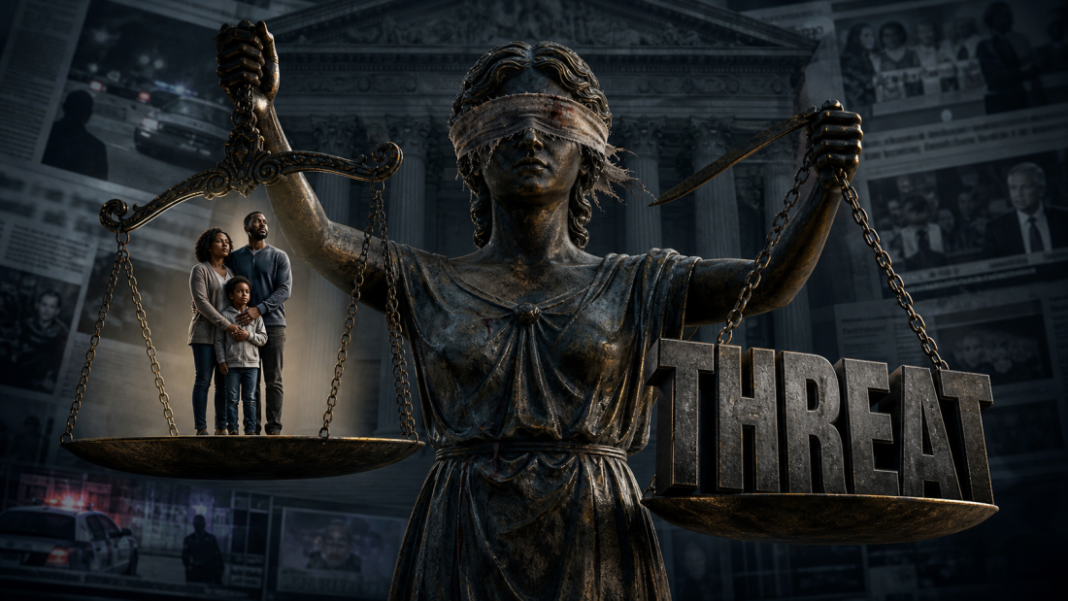
The word “threat” is a license. It requires no proof, no weapon, and no crime. It requires only a Black body and someone willing to say the word out loud. Once it is said, everything that follows becomes justified, or at least defensible. The presumption of innocence evaporates. The presumption of safety vanishes. Sometimes the presumption of life itself is gone. That is not an accident. That is the system working exactly as designed.
LaMar Cook is a Springfield man who pleaded not guilty to drug trafficking and firearms charges. He has not been convicted of anything. For weeks after his arrest, regional press described him as a “danger to the community” with a confidence no jury had been asked to share. One outlet attempted to connect a family member’s lottery winnings to his bail arrangement and, by its own admission, could not confirm the family relationship. It ran the story anyway. His character was not indicted. It was executed before trial, without evidence, without consequence to those who did it.
There is something else about the Cook case that I need you to understand. Cook was arrested in late October 2025. On October 29, 2025, a Hampden County jury was rendering its verdict in my own lawsuit against the City of Springfield and Mayor Domenic Sarno. I had sued for wrongful termination after the mayor fired me in 2020. The jury awarded me $750,000. The district attorney announced Cook’s arrest at the exact moment that verdict was being delivered. One story about a Black man’s vindication. One story about a Black man’s alleged criminality. The press chose which one to cover.
My case had been in front of regional media for five years. Reporters appeared in and out of that courthouse for a week and a half during trial. When the jury spoke, not one regional outlet covered the verdict. Not one. MassLive covered it eventually, and so did WWLP. When they did, they quoted the mayor and his team. The man who was found to have been illegally retaliated against was not asked to speak in his own vindication. The man who lost the case was given the microphone.
That is not oversight. That is the same editorial judgment at work in the Cook coverage, applied in reverse. A Black man accused fills airtime. A Black man vindicated does not make the news.
I know something about that machinery from the inside. In 2020, Mayor Domenic Sarno fired me after twelve years as his aide. I had posted a reference to the HBO series “Lovecraft Country” on Facebook, during the summer of George Floyd’s murder, when the entire country was in open conversation about white racist violence. The mayor called it a threat. He used city government to investigate my social media and terminate me. He did not need proof. He needed the word and the power to wield it. This past October, a Hampden County jury awarded me $750,000 and found I had been illegally retaliated against. I am grateful for that jury. I am also clear-eyed: most people do not get a jury. Most people do not survive long enough to get to one. And even when you win, the press gives the microphone to the man you beat.
Trayvon Martin was seventeen, unarmed, walking home through a gated community in Sanford, Florida, in 2012. A self-appointed neighborhood watch coordinator decided Martin looked suspicious. He followed him, confronted him, and shot him dead. The jury acquitted. The word “suspicious” was the license.
Ahmaud Arbery was twenty-five, jogging near Brunswick, Georgia, in 2020. Three men decided he looked like a burglar. They armed themselves, pursued him in trucks, cornered him, and killed him. They were eventually convicted of federal hate crimes, but only after video evidence forced the hand of authorities who had been prepared to let it go. The word “suspicious” was the license.
Jordan Neely was thirty, unhoused, in a mental health crisis on a New York City subway car in 2023. A passenger placed him in a chokehold and held it until Neely died. Witnesses described Neely as distressed, not violent. The jury acquitted. The word “threat” was the license.
Cyrus Carmack-Belton was fourteen in Columbia, South Carolina, also in 2023. Store owner Chikei Rick Chow and his son chased him 130 yards from the store and shot him in the back. The stated reason: suspicion of stealing four bottles of water. Video showed Cyrus returned the bottles before leaving. He stole nothing. Multiple witnesses said he never pointed a gun. The only witnesses who said he did were named Chow. On June 1, 2026, the jury returned a verdict of not guilty. His family’s statement said, “Yesterday a jury watched our fourteen-year-old boy run away from two grown men on video.” They knew one of them shot him in the back and they still said no one is to blame. ” The word “threat” was the license.
These cases feel like separate incidents if you let them. They are not. Black Americans make up twelve percent of the United States population and twenty-six percent of fatal police shootings. Black males face a lifetime fatality rate of 96 per 100,000 in police encounters, compared to 39 per 100,000 for white males. A study from Ohio State University found that white mass shooters are 95 percent more likely to be described as mentally ill in press coverage than Black shooters. The Equal Justice Initiative documents that mugshots appear in 45 percent of Black defendant news coverage versus eight percent of white defendant coverage. Research by communication scholar Robert Entman found that 38 percent of Black suspects were shown physically restrained in news images, compared to 18 percent of white suspects. The media does not just report on Black threat. It manufactures it.
The law does not just permit the perception. It protects those who act on it. Stand Your Ground statutes in dozens of states codify the right to use deadly force based on a subjective belief. Citizen’s arrest statutes, some dating to the Civil War, were always designed to be weaponized against Black people. When a jury acquits a man who shot a child in the back after chasing him 130 yards, the law is not failing. It is functioning.
I am writing this with a Springfield lens, the same city where LaMar Cook is fighting charges that have not been proven. I am writing it as a man who fought the institutional version of this machinery and won a partial victory after years of legal battle, with attorneys and resources most people in this community cannot access. My verdict changed nothing about how the mayor operates. What it gave me was the standing to tell you what I saw from the inside.
This is not a series of unrelated tragedies. This is a system with a consistent input and a consistent output. The input is a Black person, in any context, doing anything or nothing. The output is “threat,” “license,” and “consequence.” The consequences range from a destroyed reputation and career to a destroyed life.
Name the system. Refuse the narrative that each of these cases stands alone. The word “threat,” applied without evidence and without accountability, is not a description. It is a weapon.
Are you tired yet?