



By Brother Dulani Dumisai
Bro. Geb constructs a well-intentioned but fundamentally flawed critique of the International Social Movement for Afrikan Reparations (ISMAR). While Bro. Geb correctly identifies the core pillars of true liberation—sovereignty, self-determination, and the building of self-sustaining Afrikan institutions—he does so by erecting a classic strawman argument. He projects a passivity onto reparations advocates, scholars, and activists that simply does not exist within the vanguard of the global movement.
The underlying premise of his argument—that reparations advocates are waiting on bated breath for the global white supremacist power structure to voluntarily hand over justice—must be flatly rejected.
Dismantling the Myth of the “Petitioner”
Bro. Geb writes that reparations frameworks rest upon the “dangerous assumption that the systems responsible for African suffering may one day transform themselves into systems of justice.” He asserts that expecting these structures to voluntarily surrender power is a “dangerous political illusion.”
To anyone deeply embedded in the actual scholarship and street-level organizing of the global reparations movement, these claims are completely unfounded. No serious revolutionary Pan-Afrikan reparations advocate operates under the illusion of the oppressor’s moral evolution. We do not look to Yurugu (a worldview of domination) and mistake it for Ma’at (truth and balance).
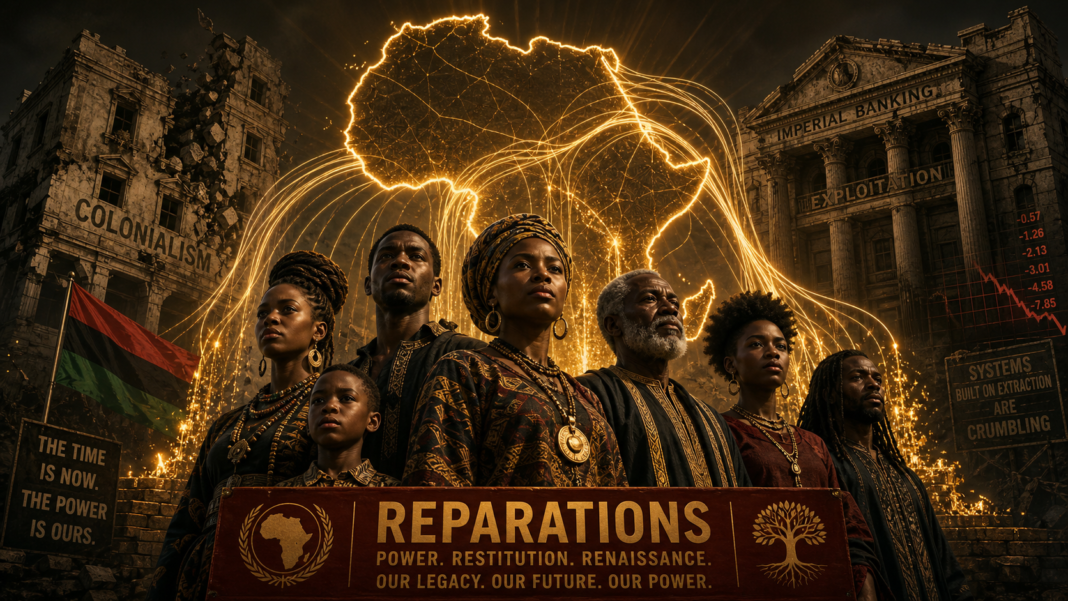
On the contrary, the fight for reparative justice has always been understood as a protracted, aggressive struggle fought on all fronts. We do not ask for reparations; we demand them as a tactical and strategic theater of war within the broader liberation struggle. Reparations are not an appeal to the conscience of the perpetrator; they are a political, economic, and legal onslaught designed to enforce accountability and exact material restitution from the systems that enriched themselves through the Afrikan Holocaust (Maangamizi).
The False Dichotomy: Power-Building vs. Reparations
Bro.Geb creates a false dichotomy, implying that one must choose between demanding reparations and building Afrikan power. This is a profound misreading of Pan-African strategies.
True revolutionary Pan-Afrikanists recognize that demanding reparations is an exercise in
power-building. The mobilization of millions of Afrikan people across the continent and the Diaspora around a unified demand for justice builds global class consciousness, unifies fractured communities, and sharpens our collective contradictions with the capitalist-imperialist matrix.
We agree entirely with the Bro Geb’s definitions of liberation: control of our land, education, economics, governance, and destiny. Afrikan families, communities, and nations must prioritize food sovereignty, technological independence, and psychological decolonization.
However, executing these points does not negate or diminish our righteous, non-negotiable demands for reparative justice.
To abandon the demand for reparations under the guise of “self-reliance” is to retroactively grant a historical and financial pardon to the architects of our suffering.
The Fallacy of “Irrelevance”
Perhaps the most logically flawed assertion in the article is the claim that “once restoration is complete, reparations become irrelevant.”
This is backward, upside-down reasoning. Reparations are the mechanism through which comprehensive, systemic restoration is achieved.
When we demand reparations, we are demanding the return of stolen land, the return of trillions in plundered mineral wealth, the cancellation of criminal neo-colonial debts, and the restructuring of international trade and the financial systems. How can reparations become irrelevant after restoration, when restoration cannot realistically be completed without the massive claw-back of the wealth stolen from us?
To suggest we can fully restore Afrikan civilization while leaving our stolen wealth entirely in the hands of the global oligarchs is historically and economically unrealistic.
As the great Pan-Afrikan giant Chinweizu correctly noted, the most vital component of reparations is our self-repair. But self-repair and structural restitution are twin engines of the same vessel. We repair our minds and organize our communities so that we have the power to force the hand of global empire and take back what is ours. Just as we done during our enslavement and colonisation. The imperialist empires were forced to relinquish chattel enslavement and eventually transitioned from direct colonialism into what we have now: neo-colonialism and some limited forms of independence. It was determination, resistance and struggle of our people that forced the hands of imperialism to shift it direct domination.
Conclusion: Sovereignty is Taken, Not Granted
John Henrik Clarke’s immortal words, cited by the Bro Geb, actually serve to validate the reparations movement: “No one gives power to people who are not prepared to take it.”
The global reparations movement is not a movement of beggars looking for a handout; it is a movement of sovereign agents preparing to take back their stolen inheritance. We do not expect the beneficiary of white supremacy to voluntarily surrender power. We intend to build the political, economic, and spiritual power necessary to make their continued dominance untenable.
We will continue to build our institutions, protect our families, and decolonize our minds. But we will never take our boots off the necks of the empires that looted Africa. The demand for reparations stands firm, not as a plea for mercy, but as a revolutionary decree of accountability.
In Ma’atUbuntu,
By Brother Dulani Dumisai