


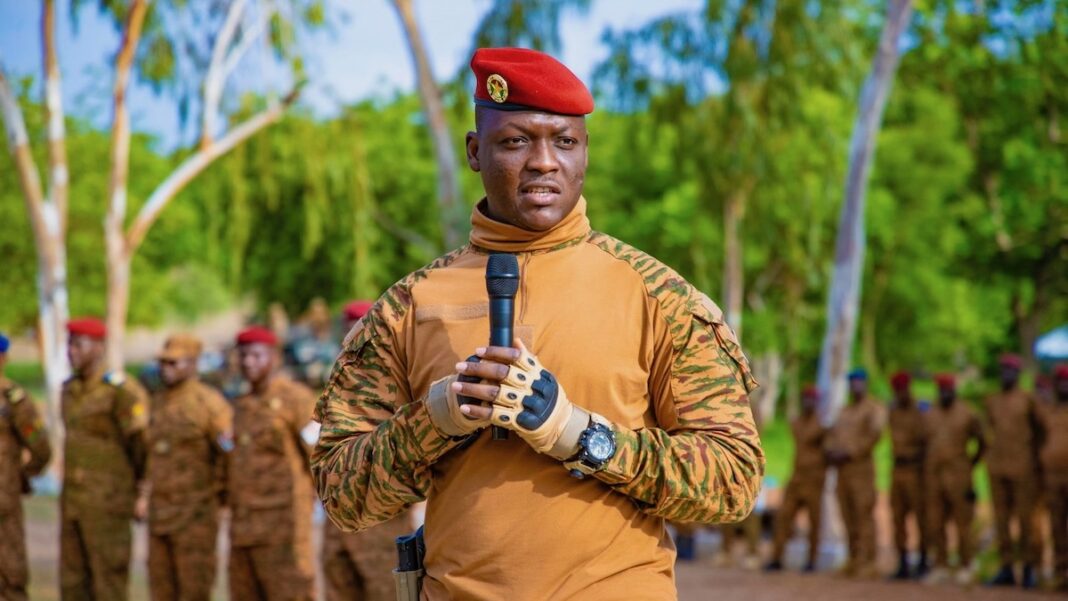

The 36-year-old military leader’s sweeping reforms and nationalist policies win popular support even as regional bodies condemn the move as anti-democratic.
By David Sinclair
Captain Ibrahim Traoré, the 36-year-old military leader of Burkina Faso, has captured both national and international attention in recent years, rising to prominence with a mix of youthful leadership, nationalist policies, and decisive military action. His popularity comes as the country faces a major political realignment: on January 29, 2026, Traoré’s junta formally dissolved all political parties, a move that had effectively been in place since his 2022 coup.
Why Traoré Resonates
Traoré’s appeal is multi-faceted. As one of Africa’s youngest heads of state, he stands in stark contrast to the continent’s traditionally older leadership, attracting support from a younger generation eager for change. His government has taken significant steps to nationalize key industries, including gold mining, aiming to ensure that Burkina Faso benefits more directly from its natural resources—a move widely seen as a rejection of foreign exploitation.
Security has also been central to his rise. Burkina Faso has long struggled with terrorism and jihadist spillover from neighboring Mali and Niger, displacing millions of citizens. Traoré has prioritized military stabilization and public safety, boosting his credibility among voters frustrated by years of ineffective civilian governance.
Defying Western influence further defines his leadership. Traoré has aligned Burkina Faso with Sahelian neighbors such as Mali and Niger while distancing the country from traditional Western partners—a policy applauded by those who favor African self-reliance.
Additionally, Traoré has cultivated an image of personal integrity, reversing salary increases for government officials while maintaining modest military pay for himself. This stance, coupled with public support for military intervention in times of perceived civilian mismanagement, reinforces his reputation as a leader focused on the people rather than personal gain.
The Political Reset
Traoré’s decision to dissolve all political parties has stirred both domestic enthusiasm and international concern. Interior Minister Émile Zerbo framed the action as necessary to “rebuild the state,” arguing that Burkina Faso’s multiparty system had fostered elite corruption, division, and social fragmentation—echoes, supporters say, of French colonial structures.
Public rallies in Ouagadougou have celebrated the move, reflecting excitement over economic gains since Traoré’s rise, including robust GDP growth, record cereal harvests exceeding six million tonnes, near-zero inflation, and new infrastructure projects such as gold refineries and airports. Supporters argue that dismantling the party system protects Burkina Faso’s sovereignty while promoting national unity.
Continental Criticism
Not all observers are convinced. The African Union (AU) has condemned the dissolution as unconstitutional, calling for the restoration of civilian political processes. ECOWAS has also expressed concern, warning that Burkina Faso’s action, along with similar steps in Mali and Niger, threatens regional cohesion and democratic standards.
Despite institutional criticism, public opinion is mixed. Social media and grassroots voices across the region have praised the move as a way to curb corruption and “reckless” multiparty politics. Yet critics warn that the crackdown—including bans on political activity and the seizure of party assets—could erode civic space and entrench authoritarian rule.
Looking Ahead
Traoré has delayed elections originally scheduled for 2024, prioritizing security, economic stability, and state rebuilding over immediate democratic processes. Whether his popularity endures will depend on his ability to translate early reforms into tangible improvements in citizens’ daily lives. For now, however, Traoré remains a figure who, in the eyes of many Burkinabé, embodies decisive leadership, national pride, and a break from the political status quo.