



Written By Darryl E. Moss
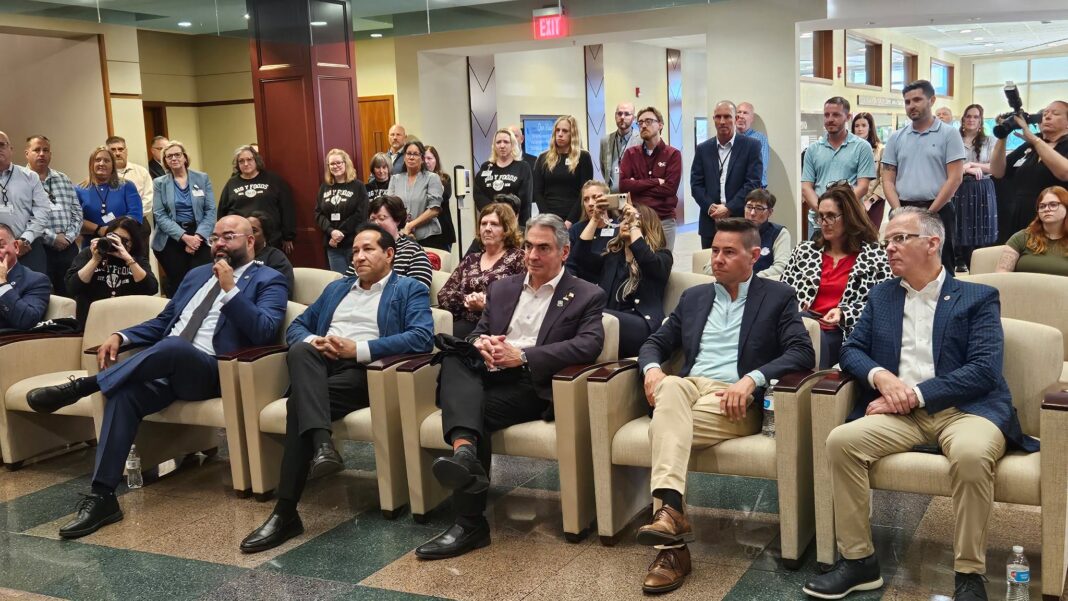
The photographs are clear.
Elected officials, business representatives, and community stakeholders are gathered for a public recognition. There are official citations, flags, cameras, handshakes, and the familiar display of political and economic relationships being affirmed in public. Yet across the photographs, Black people are absent.
That absence should not be dismissed as an oversight, an innocent coincidence, or a question of optics. It is a reflection of something much larger taking place across this country and in communities where Black people have worked, voted, built businesses, raised families, paid taxes, organized, and fought for a place at the table.
When Black people disappear from the photo op, they are often already missing from the meeting before the photo is taken. They are absent from the planning sessions, the advisory boards, the contracting conversations, the policy negotiations, the hiring decisions, and the distribution of public and private resources.
The photograph is simply the evidence.
The Picture Tells the Story
Political photo ops are designed to communicate power. They show the public who is connected, who is being honored, who has access to elected officials, and who is considered a stakeholder in the community’s future.
In these images, the people standing closest to power are overwhelmingly non-Black. The front rows, the staged presentations, and the public celebration reveal a network of business and political access that does not visibly include Black people.
This is not an argument that Black people need to be placed in photographs to make anyone comfortable. It is an argument that Black people must be present where decisions are made because those decisions affect our lives.
Black families are affected when development projects are approved, when public contracts are awarded, when businesses receive incentives, when workforce programs are funded, when schools change their priorities, when housing policies are adopted, and when political alliances determine whose phone calls will be returned.
If Black people are not in those rooms, Black communities are left to live with decisions made by others.
From the Photo Op to the Payroll
The issue is not simply who gets invited to stand beside an elected official for a picture. The issue is who receives the contract, the job, the promotion, the appointment, the grant, the investment, and the opportunity to build generational wealth.
Too often, Black people are welcomed as voters but excluded as decision makers. We are consulted after plans have been made, invited after the guest list has been created, and celebrated during election season while remaining absent from the payroll, the boardroom, and the budget.
That is the difference between symbolic inclusion and actual power.
A community cannot claim to value Black people while Black-owned businesses are overlooked for contracts, Black professionals are missing from leadership roles, Black students lose support systems, and Black families continue to struggle for economic security. Public statements about opportunity mean very little when the same circles continue to receive the access, the investment, and the influence.
The question is not whether Black people are capable, qualified, or present in the community. We are. The question is whether those who control political and economic access are willing to share power.
The Cost of Being Left Out
The rollback of diversity, equity, and inclusion initiatives has made this moment even more dangerous. Across government, higher education, and the private sector, programs intended to address unequal access are being cut, weakened, renamed, or abandoned.
The consequences are not abstract.
Federal employment has historically provided important pathways to stable, middle-class work for Black Americans, who hold a greater share of federal jobs than their share of the overall U.S. population. Reductions in federal staffing, including cuts affecting DEI-related work and other public service positions, therefore risk weakening one of the employment pipelines that has supported Black families.
Black women have borne a particularly heavy burden in the labor market. A 2026 report found that Black women accounted for 54.7 percent of women’s job losses in 2025, even though they represented 14.1 percent of the female workforce. These are not just statistics. They represent mothers, caregivers, professionals, homeowners, entrepreneurs, and breadwinners whose lost wages affect children, households, churches, neighborhoods, and entire communities.
College students of color are also reporting the loss of mentors, scholarships, diversity offices, and programs that helped them navigate institutions where they have historically been underrepresented. When support systems are dismantled, the message becomes clear: Black students are expected to survive without the structures that helped create a fair chance to succeed.
At the same time, corporations are retreating from commitments that created openings for minority-owned businesses and professionals. Walmart, for example, announced that it would no longer prioritize suppliers based on whether they were women or minority-owned and would not renew its racial equity center. When companies step back from supplier diversity, Black businesses risk losing access to the relationships and contracts that help them hire workers, sustain operations, and build wealth.
Absence Is a Political Decision
Black absence is often treated as though it simply happened. It did not.
Someone decides who is invited. Someone decides who receives the call. Someone decides whose business is recommended, whose organization is considered legitimate, whose voice is included on a panel, and whose concerns are treated as urgent.
The exclusion may not always be announced. It may not be written into policy. But it can be seen in the results.
It can be seen when political leaders repeatedly stand with the same people while Black leaders remain outside the circle.
It can be seen when public money circulates among the same businesses and networks while Black entrepreneurs are told to wait, apply again, or prove themselves one more time.
It can be seen when Black communities are asked for their votes but not their vision.
It can be seen when a room full of people celebrating community progress does not visibly reflect the Black community that is also expected to live with its outcomes.
This is what structural exclusion looks like in real time. It is not always a slammed door. Sometimes it is a door that is never opened.
Black People Need Power
The answer is not a symbolic invitation or a single Black face added to a photograph after concerns are raised. Black communities do not need tokenism. We need political and economic power.
That means Black people must be included from the beginning in the conversations that determine the future of our communities. It means Black-owned businesses must have meaningful access to public and private contracts. It means Black professionals must be recruited, hired, promoted, and appointed into positions where they can influence decisions. It means Black organizations must be funded, not merely praised. It means Black families must benefit from development, not be displaced by it.
We cannot afford to keep being palatable while our communities lose ground.
There is nothing offensive about naming exclusion when we see it. There is nothing divisive about demanding that Black people be included in the political and economic life of the communities we help sustain. And there is nothing unreasonable about asking why, in rooms filled with political leaders and business decision makers, Black people are still missing from the picture.
Because when Black people disappear from the photo op, the danger is that we will also disappear from the payroll, the contracts, the appointments, the policies, and the future being created around us.
And that is not simply a problem with the picture.
It is a problem with power.
Editor’s Note: This is not a complaint. It is a reminder and a notice of what happens when Black people are not in the picture. Too often, it means we are not in the room. And when we are not in the rooms where political, economic, and community decisions are made, decisions affecting our quality of life, our families, our businesses, and our future are made without us.