


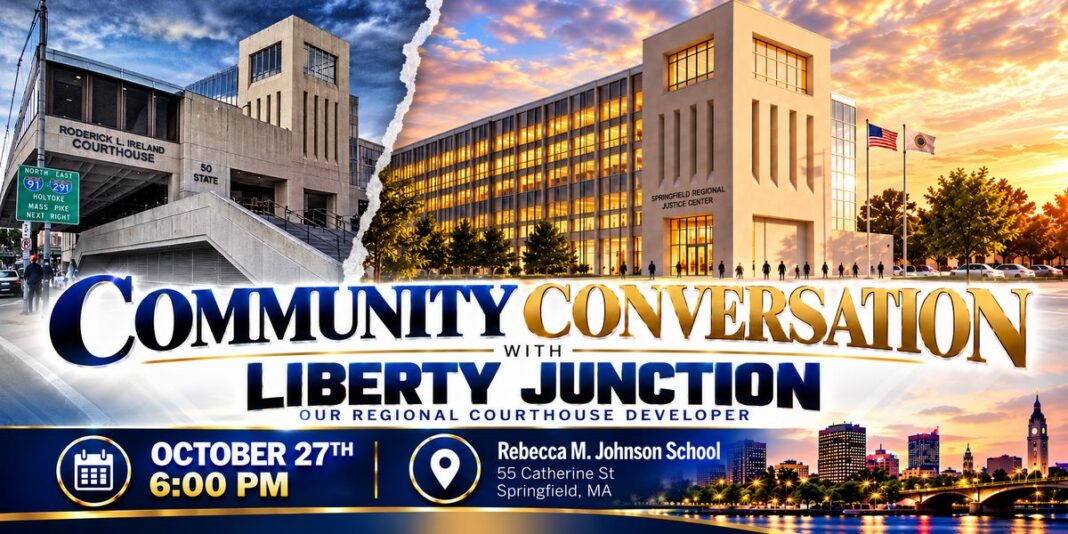

SPRINGFIELD, Mass. — Springfield elected officials and community leaders will host a public discussion Tuesday, Oct. 27, about the proposed Liberty Junction courthouse development, emphasizing opportunities for local workers, minority owned businesses and returning citizens as the project moves through state lease negotiations.
A press conference will begin at 4:30 p.m., followed by a community conversation at 6 p.m. at Rebecca M. Johnson School, 55 Catherine St. Organizers say residents, neighborhood organizations and business owners will have an opportunity to ask questions and learn about potential employment, construction contracts, workforce training and downtown economic development.
The gathering comes as Liberty Junction works toward an agreement with Massachusetts to build a new Springfield Regional Justice Center at 125 Liberty St., near Union Station. The state conditionally selected the development team this summer to replace the aging Roderick L. Ireland Courthouse and consolidate court operations in a new facility.
State Rep. Bud L. Williams said the development should create opportunities for people and businesses that have not always benefited from major construction projects.
“Projects of this scale should create jobs, strengthen our local economy, and open doors for Springfield residents and businesses,” Williams said. “Too often, communities of color are left out of major development projects or see the benefits pass them by. Liberty Junction presents an opportunity to do things differently.”
“That means making sure Springfield’s workforce, minority-owned businesses, and neighborhoods are included in the jobs, contracts, training, and economic growth connected to this investment,” he said.
What Liberty Junction proposes
Liberty Junction is a development partnership involving FD Stonewater and CoJo Partners, with Suffolk Construction serving as general contractor. The proposed justice center would include 30 courtrooms. The broader development footprint covers approximately seven acres, including the courthouse site and properties at 280 Chestnut St. and 616 Dwight St.
The developers also envision a mix of housing, restaurants and space for small businesses around the courthouse. Those plans represent a broader redevelopment vision rather than completed or guaranteed investments.
Although the project is widely described as a $2 billion investment, that figure is not the courthouse’s construction price alone. Published estimates put construction at $462 million to $525 million. The approximately $2 billion figure includes lease payments and operating costs over 40 years.
Under the proposed arrangement, a private development team would construct the facility and lease it to Massachusetts. State officials say that approach would deliver a replacement courthouse sooner than conventional state funded construction, which they contend could not produce a building ready for occupancy until at least the mid 2030s.
The selection remains conditional. Liberty Junction must satisfy state requirements and execute a lease before proceeding with development. The team has indicated it can deliver the project within 42 months of lease execution.
Harris calls court ruling a victory
Conan Harris, a member of the Liberty Junction development team, described a recent court ruling allowing the process to continue as a measure of justice.
Two unsuccessful bidders sued to challenge the state’s selection. A Superior Court judge denied their request for a preliminary injunction on Aug. 24. The ruling allowed the process to move forward but did not resolve the underlying lawsuit.
“I think it’s justice. The word that comes to mind is justice. That’s the word that comes to mind immediately. What we’ve always known is it’s been a fair process, a long process, but a fair one and we just put our best foot forward by putting together the best project possible to be able to mitigate harm that existed in the courthouse,” Harris said.
Harris said he wants attention to return to the physical condition of the existing courthouse and the urgency of replacing it.
“The story that’s not always told is the courthouse is a sick building, and people would get sick to the point where…a person had passed away through the sickness of that building, all the way to the point where the state was ringing [the] alarm button to get this building redone,” he said.
The replacement effort follows longstanding complaints about the existing courthouse, including mold and building deterioration. While supporters argue that Liberty Junction offers a path to a modern facility, the proposal has drawn objections over its location, cost and selection process.
State officials have defended their decision, saying Liberty Junction ranked among the strongest proposals on qualitative measures and offered an estimated total occupancy cost approximately $300 million below the next lowest proposal over the 40 year lease term.
Local leaders emphasize access to jobs and contracts
City Councilor Justin Hurst said Tuesday’s meeting is intended to help residents and businesses position themselves for potential opportunities.
“It is refreshing to finally have a developer of a major project taking place in this city who is committed to ensuring all Springfield residents, local contractors, small businesses and returning citizens are aware of the opportunities to come and are in position to take advantage of them,” Hurst said.
“We are tired of being left out of the discussion and are excited at the possibility of finally having a seat at the table,” he said. “This 2 billion dollar investment has the potential to change the trajectory of people’s lives and serve as a model for other developers wanting to do business in our city.”
School Committee Vice Chairwoman LaTonia Monroe Naylor said the project could create connections between education and employment.
“As Vice Chair of the Springfield School Committee, I believe major development projects present opportunities to invest in more than buildings,” Monroe Naylor said. “They create an opportunity to engage our young people, connect education to real-world experiences, and ensure that Springfield’s next generation has a place in the economic growth of our city.”
Community advocate Charles Stokes linked access to skilled trades and stable employment with efforts to prevent violence.
“For decades we told our young people to put down the guns and the drugs but never gave them anything to pick up,” Stokes said. “Liberty Junction will finally give them something to pick up; through pre-apprenticeships, apprenticeships, journeyman contracts, union cards, and careers with meaningful opportunities to provide for their families.”
“This is why I support Liberty Junction. This is real gun violence intervention, and this is real gun violence prevention!” he said.
Massachusetts prevailing wage requirements would apply to courthouse construction as though it were a publicly constructed building, according to state officials. The event announcement does not specify local hiring targets, minority business contracting percentages or enrollment procedures for the workforce opportunities it describes.
Whitfield calls for community participation and a modern courthouse
City Council President Tracye Whitfield said community involvement and efforts to replace the existing courthouse should move forward together.
“True development is about more than buildings. It is about opportunity, equity, and economic growth,” Whitfield said. “Every resident deserves a seat at the table, a voice in the process, and a fair chance to benefit.”
Whitfield said she supports bringing project information directly to residents and creating opportunities for workforce development and local businesses. She also emphasized the need to address conditions in the current courthouse.
“But meaningful progress must also address the urgent need for a safe, healthy, and modern courthouse,” she said. “Our community deserves both a voice in its future and a facility worthy of the people it serves. It is time to move forward and get our people out of a sick building.”
Tuesday’s community conversation is intended to give residents an opportunity to hear more about the proposal and ask how its anticipated economic benefits could reach Springfield households, workers and businesses.