



Editor’s Note:
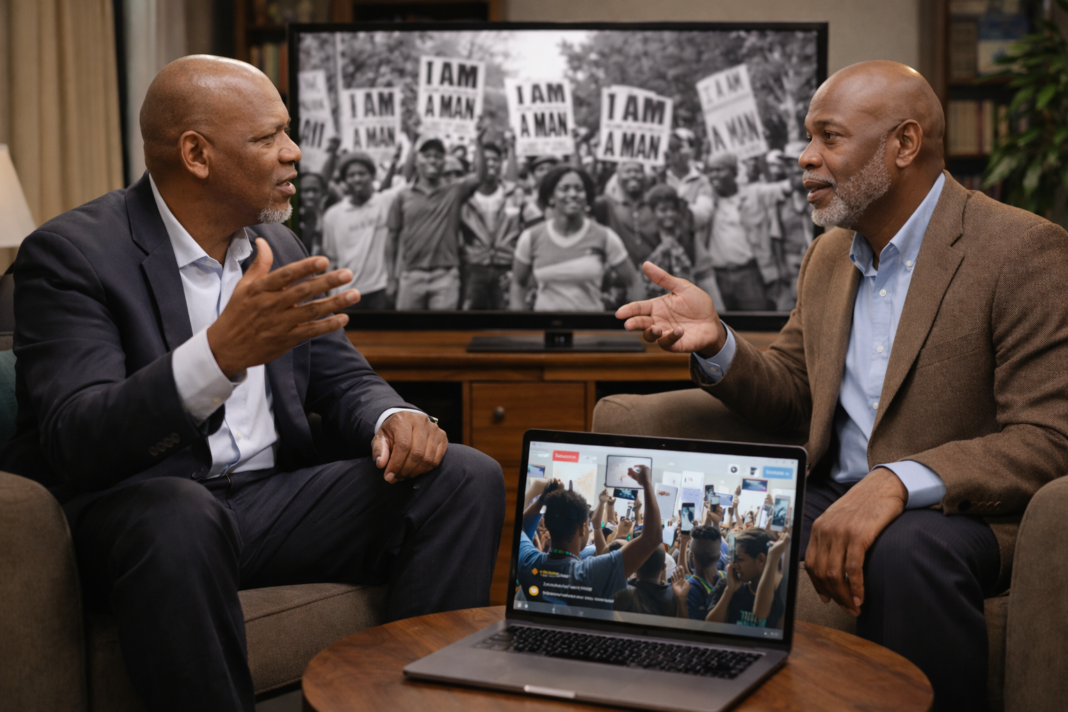
Within Black communities across the country, and here in Springfield, an ongoing debate is unfolding about what activism looks like in the digital age
Some believe the rise of social media has created a generation of “armchair revolutionaries,” quick to critique but slow to build. Others argue that digital platforms have simply expanded the arena of activism, allowing voices and ideas to travel further and faster than ever before.
To explore this tension, The Metro Record presents two perspectives. First, a column by Darryl Moss challenging what he sees as performative online activism. Following that, a counterpoint from contributing writer David Sinclair, who argues that digital engagement has become a legitimate and necessary extension of modern movements.
The goal is not to declare a winner, but to deepen the conversation.
Because the future of community leadership may depend on how we bridge these two worlds.
The Rise of the Armchair Revolutionary
By Darryl Moss
In today’s social media circus, anyone with Wi Fi and a loud opinion can declare themselves a “leader” in the Black community.
No boots on the ground.
No sleepless nights organizing.
No risk taken.
No skin in the game.
Just a ring light, a recycled Malcolm X quote, and a fire emoji caption, and somehow that makes them a voice for the people.
These unapologetic, armchair pro Black revolutionaries love to speak in absolutes. What is and is not Black. Who is woke, who is a sellout. They judge community organizers, teachers, artists, and elders from the comfort of their couches.
Meanwhile, the people feeding kids on Saturdays, helping expunge records, mentoring youth, and pushing policy forward are dismissed because their work does not fit someone’s online definition of “the movement.”
Too often, the performance becomes the point.
The loudest voices in the room are frequently the ones who have never built anything. Never started a nonprofit. Never mentored a child. Never knocked on a door, fed a family, ran a program, or helped heal a wounded spirit.
But they type with fury. They yell with conviction. They curse the system while doing little to understand it, let alone dismantle it.
And yet, they attract followings. They are quoted, reposted, and elevated as thought leaders.
Meanwhile, those doing the real work in communities are overlooked, underfunded, and sometimes attacked by the very people who claim to be fighting for the same cause.
This is not a call for silence. Speak your truth. Use your platform.
But understand the weight of your words.
If all you offer is critique without contribution, you are not a revolutionary. You are a commentator.
If you have sacrificed nothing, built nothing, and served no one, you are not leading. You are spectating.
The movement is more than memes and monologues.
It is messy. It is complicated. It is slow. And it is often thankless.
But it is real.
And real change requires more than a post.
It requires presence.
So to the armchair radicals, either stand up and show up, or kindly sit this one out.
The stakes are too high, and our people deserve more than hashtags.
Counterpoint
The Revolution Has Gone Digital
By David Sinclair
Darryl Moss raises a concern that resonates with many longtime organizers, the rise of what he calls “armchair revolutionaries,” individuals who speak loudly online but rarely show up in the real work of community building.
It is a critique worth hearing.
Anyone who has spent time organizing in neighborhoods, mentoring youth, or pushing policy through difficult institutions understands that real change rarely happens through hashtags alone.
But dismissing digital activism entirely risks overlooking how movements have always evolved with technology.
During earlier eras of Black political struggle, pamphlets, church newsletters, Black newspapers, and radio broadcasts helped spread political awareness and coordinate action.
Today, many of those conversations happen online.
Social media platforms have become spaces where people learn about history, debate policy, document injustice, and organize collective responses in real time. A single post can rally support for a community fundraiser. A thread can break down complex policy for thousands of readers. A viral video can expose wrongdoing before traditional media outlets even arrive on the scene.
For younger generations especially, digital spaces are often where civic awareness begins.
That does not replace organizing in the streets or in neighborhoods. But it can amplify it.
Critics are correct that some people perform activism online for attention. Yet performative activism is not new. Every era of political struggle has had individuals more interested in visibility than impact.
The difference today is scale.
Technology allows ideas to spread faster and further than ever before.
When online voices and community organizers work together rather than dismiss each other, movements become stronger.
The neighborhood builder matters.
The teacher matters.
The organizer who knocks on doors matters.
But so does the communicator who can translate complex ideas into messages that reach thousands across digital networks.
The struggle for justice has never been confined to one arena.
It happens in community centers, classrooms, council chambers, and increasingly, on screens.
The streets still matter.
But today, the revolution is also being posted, streamed, and shared.
The real challenge is not choosing between the two.
It is learning how to use both.
Join the Conversation
What do you think?
Is activism being diluted by social media, or expanded by it?
The Metro Record invites readers to submit letters or commentary responding to this debate.
Email: editor@themetrorecord.com
Selected responses may be published in an upcoming edition.