



When images of power are allowed to soften the reality of harm, journalism risks protecting institutions instead of informing the public.
By Darryl Moss | Opinion | The Metro Record
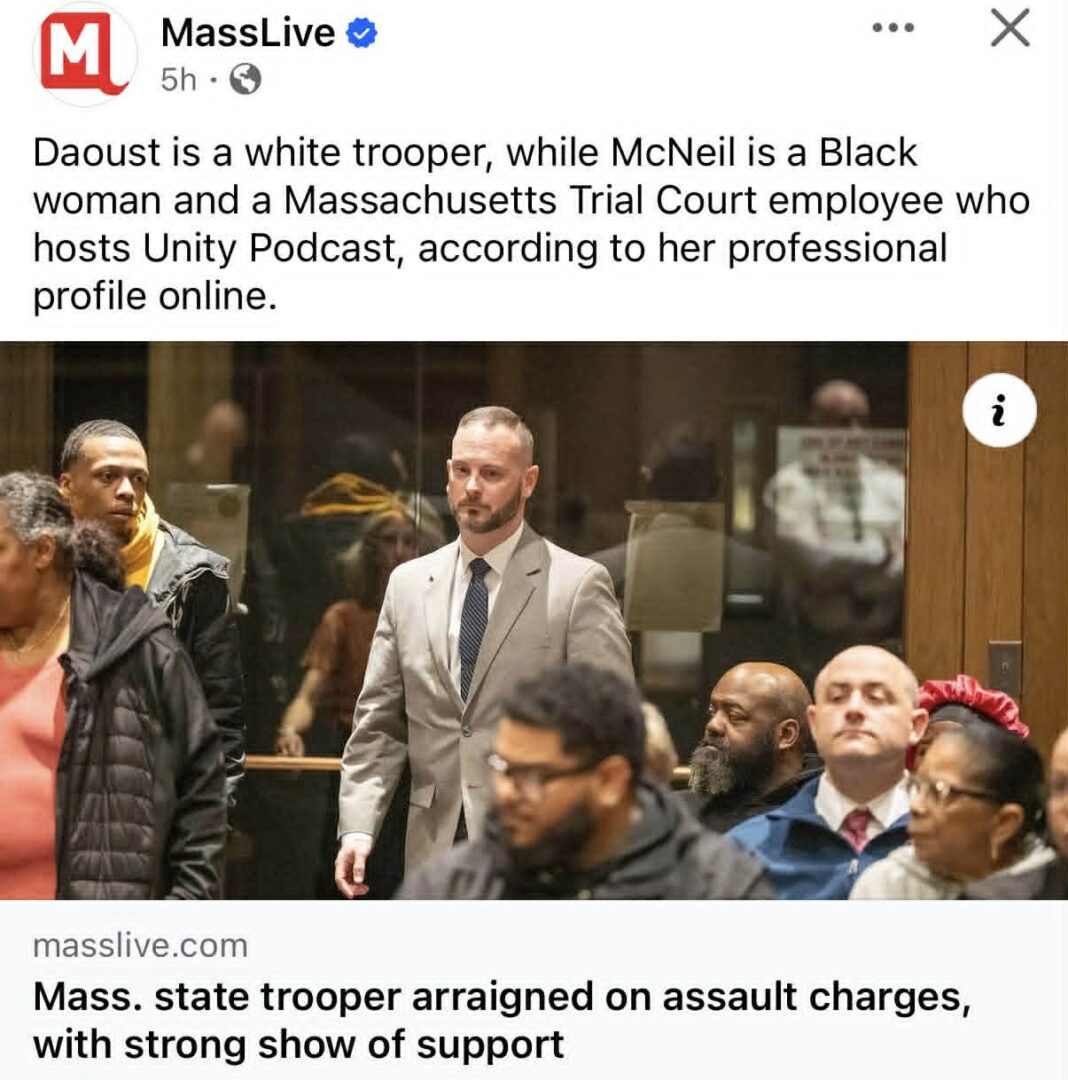
The photographs from Massachusetts State Trooper Joel Daoust’s arraignment at Springfield’s Roderick L. Ireland Courthouse are doing precisely what images of power are often designed to do.
They calm the public.

A suited officer walking confidently into court.
A composed face seated quietly in the courtroom.
Rows of fellow troopers behind him in what media captions have described as a “strong show of support.”
To many readers, the visual message is immediate: professionalism, credibility, and institutional confidence.
But images do not always tell the truth. Sometimes, they are used to soften it.
Because outside the carefully framed courtroom stills is another reality altogether, one captured not through polished press photography but through body camera footage from the February 2025 traffic stop that led to the charges now before the court.
That footage is not dignified. It is not orderly. It is not reassuring.
It is shaky night vision.
It is confusion.
It is force.
It is pepper spray discharged into a driver’s face during a struggle that prosecutors now say rises to the level of assault with a dangerous weapon.
That is the story that should lead.
Instead, once again, the public is being asked to absorb the incident through the familiar lens of institutional sympathy.
This is where local media too often fails the public.
When outlets foreground courtroom support, rows of uniforms, and carefully selected images of composure while the violence itself is pushed into secondary framing, journalism risks becoming image management for power.
That is not reporting.
That is narrative construction.
Springfield has lived too long with unresolved tensions around policing, use of force, and public trust for us to pretend these editorial choices are neutral. Every image, every caption, every decision about what leads and what follows helps shape how readers are expected to interpret power.
A courtroom filled with troopers is not simply a fact. It is a visual statement.
It signals institutional protection.
It projects credibility.
It invites the public to see solidarity before scrutiny.
Meanwhile, the person on the receiving end of the force often becomes secondary, flattened into legal language, reduced to a name in the body of the story.
That imbalance matters.
It matters especially in a city where Black and brown communities have repeatedly raised concerns about policing, accountability, and whether justice operates equally depending on who wears the badge and who does not.
Even the racial framing often used in these stories deserves closer examination.
When reports note that Daoust is white and the woman involved is Black, that information should open the door to meaningful discussion about historical disparities, enforcement patterns, and structural inequities.
Too often, however, it is inserted without analysis, leaving readers with a cue for division rather than context for accountability.
That is not depth.
That is shorthand.
And shorthand has consequences.
The public begins to consume police violence as procedural drama rather than community harm. The institution remains humanized while the injury, fear, and public distrust become abstract.
This is how systems preserve themselves.
Nobody is arguing against due process. The court must do its work.
But the media must do its work as well.
That means centering the actual stakes of the case, the bodycam footage, the use of force, the prosecutorial allegations, and the broader public policy questions that come with them.
It means asking why the show of solidarity itself is considered newsworthy.
It means refusing to allow courtroom optics to eclipse the allegations on camera.
Because when coverage humanizes power before it interrogates it, journalism stops serving the people and starts protecting the institution.
Springfield deserves better than optics.
It deserves truth that does not flinch.
And until our local coverage reflects that, public trust will continue to erode one carefully framed image at a time.
The question is no longer what happened on camera.
The question is why the image of support keeps receiving more protection than the people harmed by what the camera captured.