


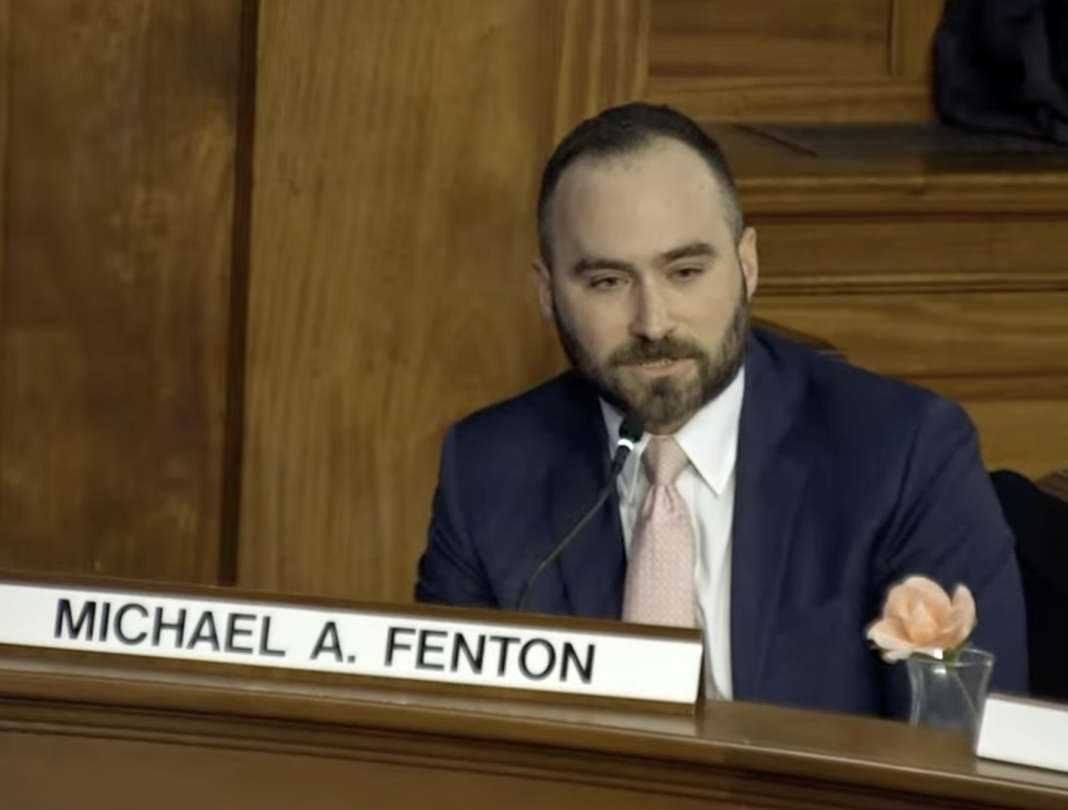

As Mike Fenton seeks a powerful but overlooked role, past actions and present questions collide over what justice will look like in practice
By Darryl E. Moss
For Black residents in Springfield, the courts are not abstract. They decide who stays housed, who is sentenced, and how fairness is applied or denied. So when a local official seeks influence over who becomes a judge, it is not routine politics. It is a question of who gets to shape justice for a generation.
The Governor’s Council is an eight-member body that operates largely out of public view, but holds decisive authority over judicial appointments in Massachusetts. Every judge nominated by the governor must be approved by the Council, a process that determines who will preside over criminal cases, housing disputes, and civil matters across the state. Because most judges serve until age 70, those decisions shape the legal landscape for decades.
Springfield City Councilor Mike Fenton is now seeking a seat on that body, a little-known institution with outsized influence over the direction of the state’s judiciary.
Fenton enters the race with structural advantages. He has served on the City Council since 2010, built deep ties within legal and political circles, and works as an attorney representing businesses, lenders, and developers. In a low-visibility race, that network is not incidental. It is power.
His campaign is centered on “regional equity,” a message that resonates across Western Massachusetts. But in Springfield, particularly among Black residents, the question is not just whether the region is represented.
It is what that representation looks like in practice.
That question sharpened following Fenton’s role in calling for the resignation of City Council President Tracye Whitfield, the first Black woman to hold the position. The effort was framed around ethics concerns tied to a council vote. But inside City Hall, the situation did not unfold in a vacuum.
Councilor Justin Hurst publicly challenged how ethics standards were being applied and to whom.
He pointed to a 2021 Armory Street matter in which Fenton recused himself but, according to Hurst, did not file a formal disclosure with the City Clerk. The issue, Hurst argued, drew no investigation, no formal memo, and no public scrutiny.
“When Councilor Fenton fails to file his disclosure, no one says a word,” Hurst said. “No memo, no investigation, no media scrutiny.”
Whitfield’s case followed a different path. She recused herself, sought guidance from both the Law Department and the State Ethics Commission, and the council ultimately rescinded the vote unanimously. Still, a legal memo was circulated publicly before any formal ethics ruling.
That contrast did not go unnoticed.
In Springfield, it raised a question that goes beyond any single vote or memo. Are standards applied consistently, or selectively, depending on who is involved?
Fenton did not directly resolve that tension. He dismissed the comparison and redirected focus back to Whitfield, at one point likening Hurst’s criticism to the rhetoric of Donald Trump. When addressing the Armory Street matter, he maintained that he had recused himself and disclosed appropriately, noting the project never moved forward.
But the issue was never just procedural. It was about consistency and who is held to account in real time.
This is where the conversation moves from incident to pattern.
Sociologist Robert K. Merton described the “fair-weather liberal” as someone who speaks the language of equality, but whose actions, especially when power is involved, produce very different results.
It is not about what someone claims to believe. It is about what their decisions reinforce.
The pattern shows up in ways that are easy to recognize. Standards applied unevenly. Accountability that shifts depending on who is involved. Outcomes that consistently place a heavier burden on those already navigating inequity.
In that sense, the issue is not intent. It is impact.
Because systems do not require explicit bias to produce unequal outcomes. Only decisions that allow those outcomes to continue.
For the people living with those outcomes, the distinction between stated values and actual behavior is not academic. It is the difference between fairness and something else entirely.
In Springfield, the Whitfield episode has led many residents to ask whether that pattern is playing out in real time.
Because the Governor’s Council is not symbolic. It is one of the most direct levers of long-term power in state government. The judges it confirms will shape how laws are interpreted, how discretion is exercised, and whether communities experience the system as fair or fundamentally unequal.
Fenton has spoken about the importance of judges understanding the history of racial injustice and the differing ways communities encounter the legal system. That language is familiar.
What is less clear and more consequential is how those principles are applied when power is on the line.
How standards are enforced.
How accountability is defined.
Who is challenged and who is shielded.
In a city where Black leadership has often faced intensified scrutiny, this moment does not read as isolated. It connects to a broader set of experiences that many residents already understand without needing them explained.
Fenton is now asking voters to trust him with influence over the judiciary itself.
That decision will not be measured in campaign cycles or political wins. It will be measured in courtrooms, over years, in outcomes that cannot be easily undone.
The question is not whether the role matters.
It is whether the same patterns people see now will follow him onto the bench through the judges he helps put there.