



By David Sinlair for The Metro Record
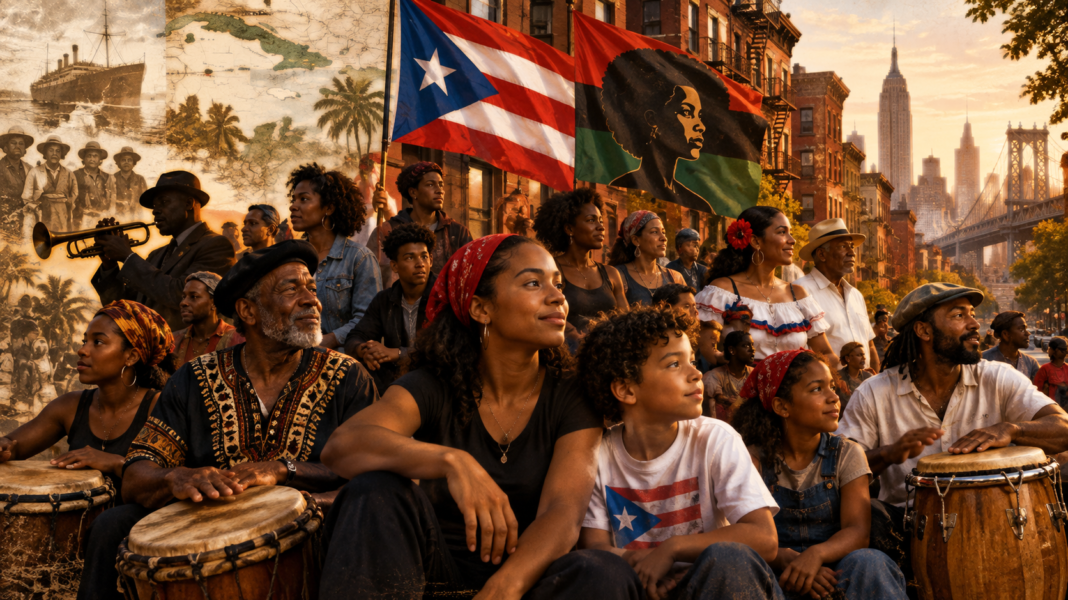
The history between Black Americans and Puerto Ricans is a story of shared roots, migration, cultural exchange, political struggle, and the continuing pursuit of dignity. From the African heritage embedded in Puerto Rican life to the streets of Harlem, El Barrio, Chicago, Philadelphia, and other urban communities, Black and Puerto Rican people have helped shape one another’s music, movements, neighborhoods, and visions of freedom.
Puerto Rican identity is often discussed in terms of language, nationality, or island heritage. But Black history is inseparable from Puerto Rican history. Africans arrived in Puerto Rico under Spanish colonialism beginning in the early 1500s, with many enslaved and forced to labor in mines, homes, plantations, and sugar production. Slavery was abolished in Puerto Rico in 1873, but its social and economic legacy continued long afterward. Afro Puerto Rican heritage remains visible in bomba and plena music, dance, foodways, religious traditions, language, and community life.
That heritage also connects Puerto Rico to the larger African diaspora, a connection that became especially visible as Puerto Ricans migrated to mainland U.S. cities during the 20th century.
A Meeting in America’s Cities
After Puerto Ricans received U.S. citizenship under the Jones Act of 1917, migration to New York and other northern cities accelerated. Puerto Rican families arrived in communities where African Americans, including migrants from the South, were already building new lives amid discrimination, economic hardship, and segregation.
Many Black and Puerto Rican residents encountered the same obstacles: unstable jobs, low pay, substandard housing, overcrowded schools, exclusion from political power, and aggressive policing. In New York City, Harlem and East Harlem became major centers of contact. Puerto Ricans created a lasting cultural presence in East Harlem, widely known as El Barrio or Spanish Harlem, while Black Harlem remained a global symbol of African American culture, political thought, and artistic achievement.
Their lives overlapped in apartment buildings, factories, schools, churches, storefronts, social clubs, labor unions, and neighborhood protests. This proximity did not erase differences in language, identity, or history. But it created relationships that were personal as well as political: friendships, shared workplaces, interracial families, artistic collaborations, and common battles for survival. The early Puerto Rican migration to New York grew after World War I and expanded through the decades that followed.
Arturo Schomburg’s Bridge
Few figures better represent the connection between Black and Puerto Rican history than Arturo Alfonso Schomburg. Born in San Juan in 1874 to a Black mother from St. Croix and a Puerto Rican father, Schomburg moved to New York City as a teenager and became one of the most important collectors and historians of the African diaspora.
Schomburg dedicated his life to documenting Black achievement at a time when mainstream institutions often ignored or distorted Black history. His personal collection of books, manuscripts, art, and historical artifacts became the basis for the Schomburg Center for Research in Black Culture in Harlem, now one of the world’s leading institutions for the study of Black life and history.
Schomburg’s legacy challenges rigid ideas about who belongs in Black history. He was Puerto Rican, Caribbean, Black, and international in his outlook. His work reflected a larger truth: the histories of African Americans, Afro Caribbean people, and Black Latin people have long been connected.
Music, Art, and Urban Culture
Culture became one of the most powerful meeting grounds between Black and Puerto Rican communities. African American jazz, blues, gospel, soul, and later hip hop mixed with Puerto Rican bomba, plena, salsa, mambo, and Latin jazz. These sounds did not develop in isolation. They were created in neighborhoods where Black and Puerto Rican musicians performed together, learned from one another, and adapted musical traditions to new urban realities.
Puerto Rican musicians contributed to the Harlem Hellfighters, the all Black 369th Infantry Regiment that became internationally celebrated during World War I. Rafael Hernández Marín, later recognized as one of Puerto Rico’s great composers, was among the Puerto Rican musicians connected to the regiment.
The exchange continued for generations. Boogaloo in the 1960s fused Latin rhythms with African American rhythm and blues. Salsa emerged from Afro Caribbean musical traditions and New York’s multicultural neighborhoods. Hip hop, born in the Bronx, was shaped by Black and Puerto Rican young people who turned turntables, dance floors, murals, spoken word, and street fashion into a global cultural force.
This shared creativity was more than entertainment. Music carried memory, identity, struggle, joy, and resistance. It gave working class people a language for telling their stories when institutions refused to hear them.
Community Organizing and Resistance
The relationship between Black and Puerto Rican communities also developed through organizing. In the 1960s and 1970s, civil rights activism, Black Power, anti colonial movements, and neighborhood campaigns helped produce a new era of multiracial organizing.
Black freedom organizations offered a model of community self determination that influenced Puerto Rican activists. The Young Lords, originally formed in Chicago and later active in New York, organized around poor sanitation, lead poisoning, tenant rights, health care, education, police misconduct, and Puerto Rican self determination.
The group’s campaigns often reflected the influence of the Black Panther Party, particularly its commitment to community control and direct action. Both movements argued that people living with poverty, racism, neglect, and police violence should have power over the institutions affecting their lives. Scholars have documented how Puerto Rican activists publicly built connections with African American struggles for racial justice during this era.
A major gathering at Madison Square Garden on Oct. 27, 1974, brought together Black and Puerto Rican voices in support of the decolonization of Puerto Rico, reflecting a broader tradition of solidarity around freedom, self determination, and human rights.
The Truth About Tension
Solidarity, however, was never automatic. Black and Puerto Rican residents sometimes competed for scarce jobs, affordable housing, public services, and political representation. Prejudice, language barriers, anti Latino bias, anti Black racism, and colorism also created division.
Puerto Ricans are not one race. They include Black, white, Indigenous, mixed race, and other people. Still, U.S. racism has often treated Puerto Ricans as outsiders based on poverty, Spanish language, ethnic identity, or racial appearance. Within Puerto Rican communities, Afro Puerto Ricans have also had to challenge the erasure of Black identity and confront the effects of colorism.
Acknowledging these tensions does not weaken the story of solidarity. It makes the story more honest. The Black and Puerto Rican relationship has always been complex because it has unfolded under systems designed to separate people, rank them, and make them compete for limited resources.
A Living Legacy
Today, the legacy of Black and Puerto Rican solidarity remains visible in cultural institutions, neighborhood organizations, labor struggles, social justice movements, literature, music, and family histories across the country. Afro Puerto Rican scholars and activists continue to call attention to Puerto Rico’s Black heritage and to challenge the ways Blackness has been overlooked in traditional narratives.
The connection between Black Americans and Puerto Ricans is not simply a chapter from the past. It is a living history, one that continues wherever communities organize for housing, education, public safety, health care, economic opportunity, cultural recognition, and political power.
Black and Boricua history reminds us that culture can be a form of testimony, community can be a form of protection, and resistance can be a shared language.